
Field note N° 06 ·
My Red Alox, Old Cross Victorinox Pioneer Rancher
The Last Pocketknife I Needed to Find
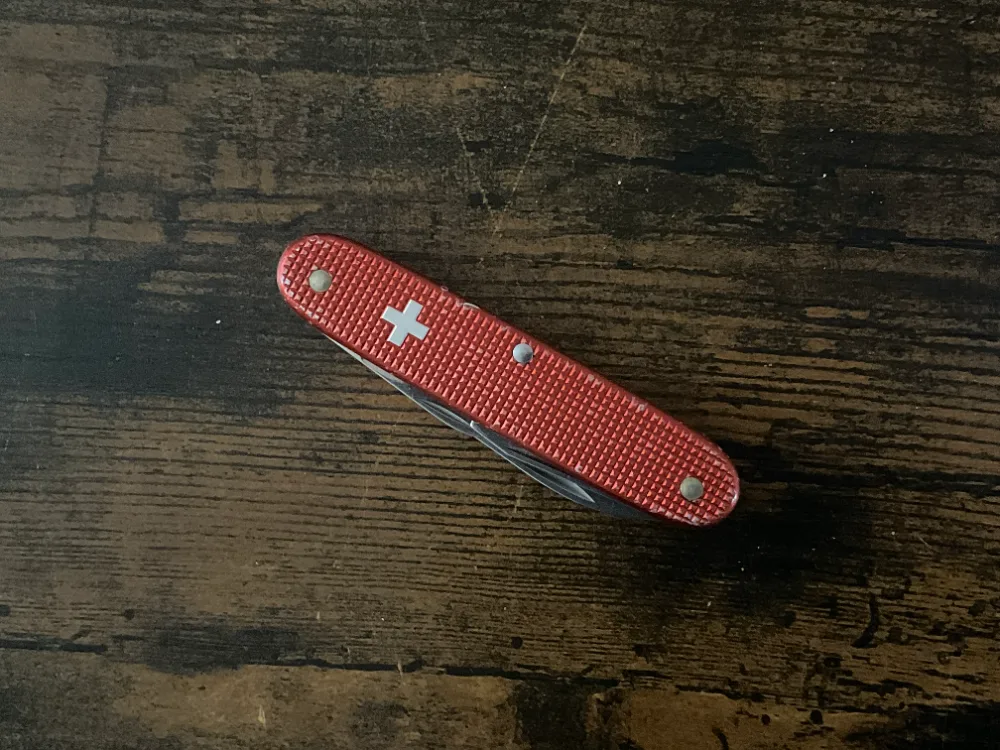
It took me years to admit what I was actually looking for. Not the biggest Swiss Army knife, not the one with the longest tool list, but a very specific one: a Victorinox Pioneer Rancher in red Alox, wearing the old silver Swiss cross. That's the model my father bought me when I was 12, and it was stolen from me a few months later. Yes, in my head, I was MacGyver. The day I was able to put my hand on another one, the search ended.

I. Four Tools, Each One Earned
The Pioneer Rancher is a 93 mm, two-layer Victorinox built on the old Soldier chassis. That heritage is not marketing; this is the tool that equipped armies, foresters and field engineers before the Swiss Army knife became a gift-shop item. And its loadout is deliberately lean:
A large drop-point blade. Full-sized, plain-edged, honest. It is scuffed at the base from real work, and none the worse for it. This is a blade that guts twine, trims kindling and opens a parcel without complaint.
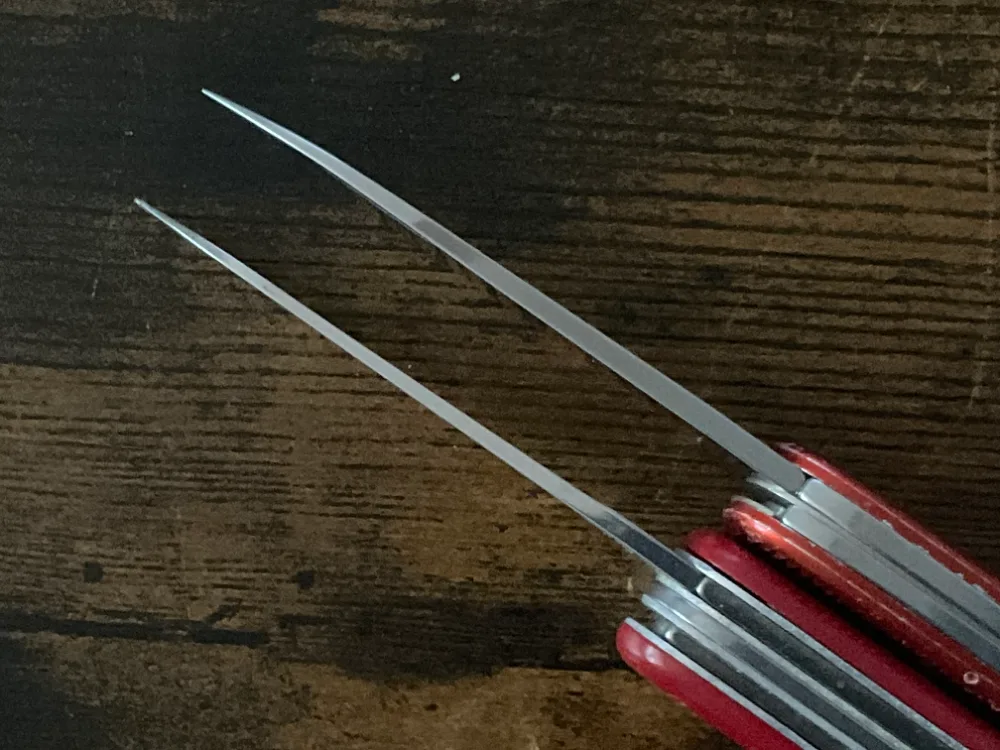
A small pruning blade. A hawkbill, hooked like a billhook reduced to pocket size, impossible to confuse with anything else once you have seen the curve next to the straight spine of its sibling. Where the standard Pioneer carries a can opener, the Rancher carries this instead. It seizes rope, cord, garden twine and stubborn zip ties. In daily practice it is the tool I reach for most. And yes, it's also the right tool to open your Amazon packages.
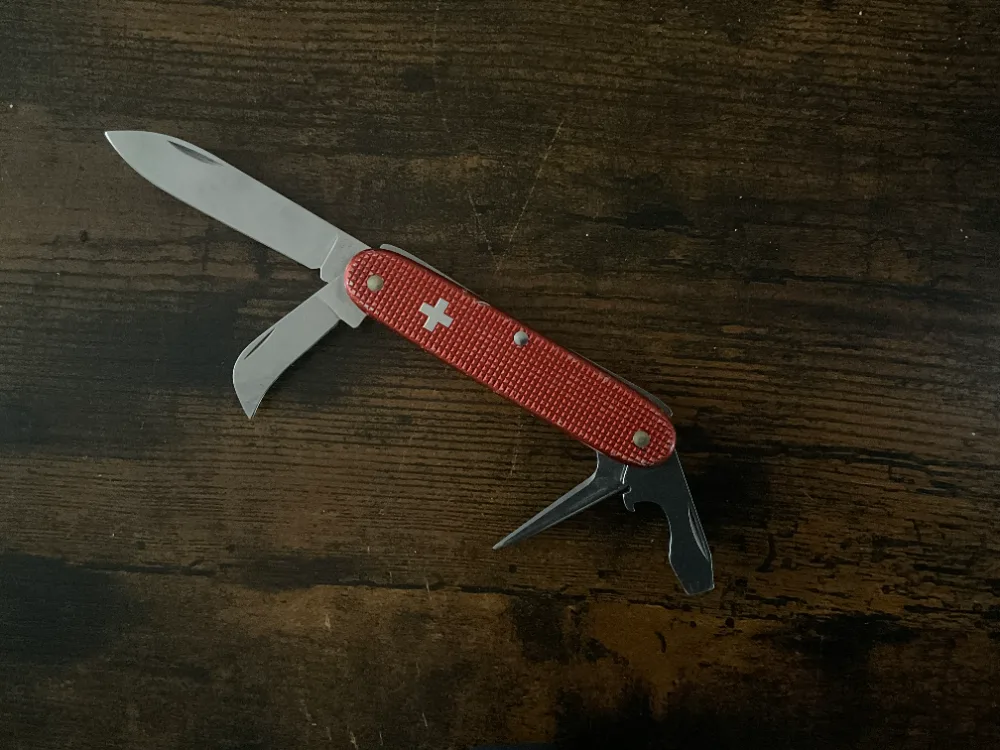
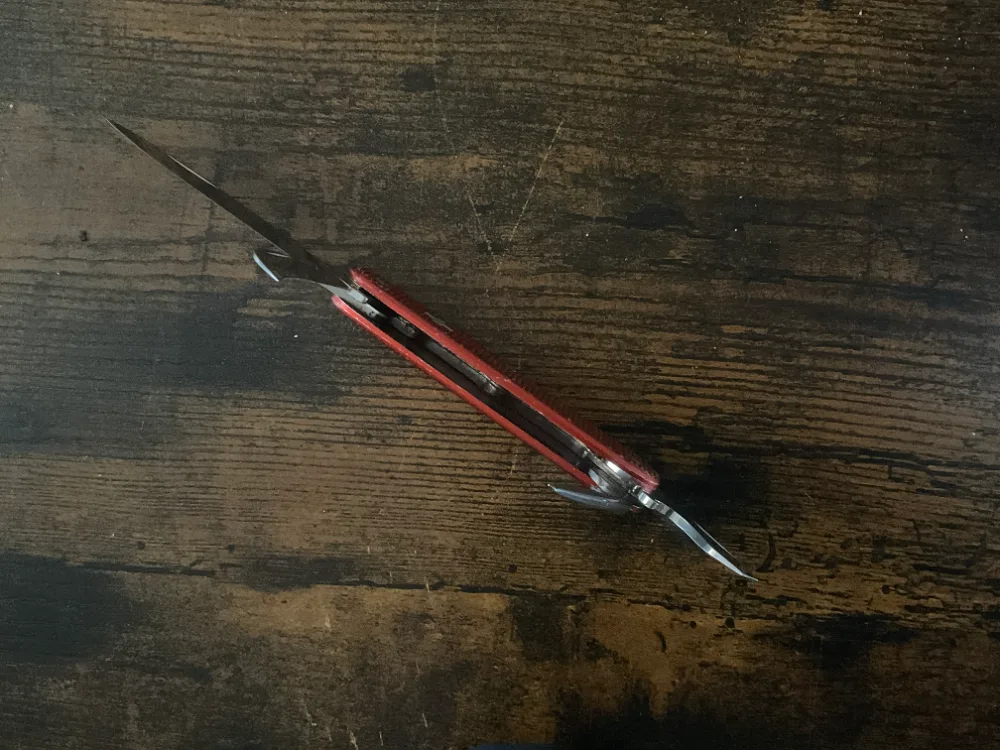
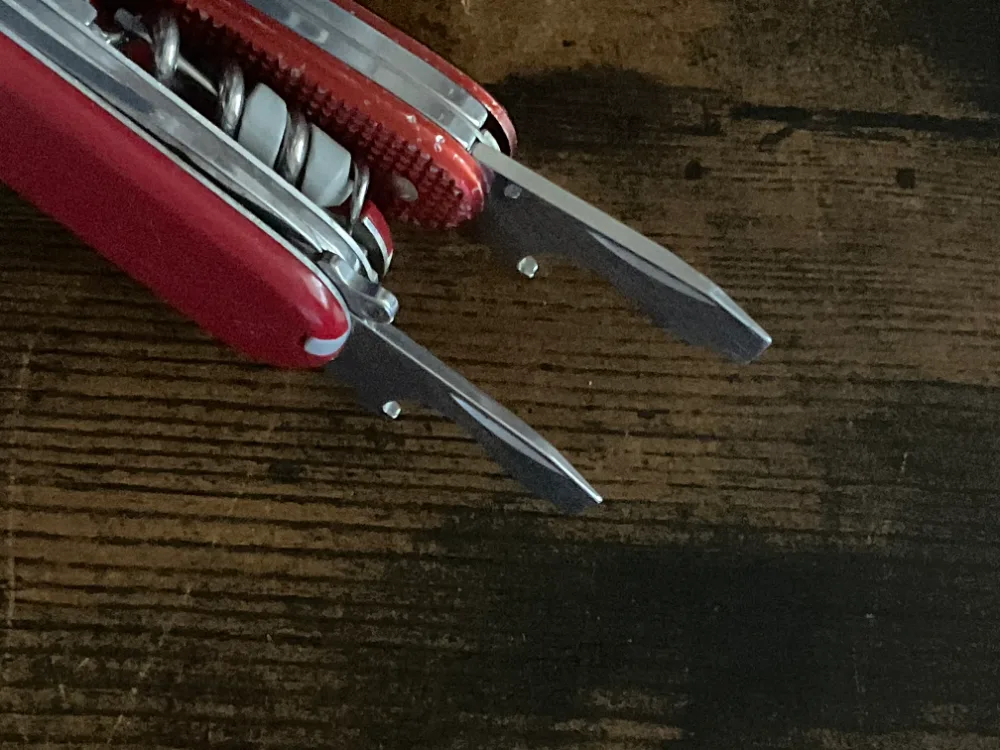
A cap-lifter with large flat screwdriver and wire stripper. The classic pry-and-twist implement of the 93 mm line, with its oval hole and squared shoulders. On this knife it doubles as a short lever, and the frame tolerates it (more on this below).
A reamer and awl. For punching leather, canvas and eyelets. There is quiet satisfaction in carrying a tool whose ancestral trade was harness-making. Making hole in leather belts is surprisingly much easier than with the awl that comes with a Cellidor swiss Army Knife
Four tools, no filler, nothing that fails to earn its place. And certainly not any plastic tooth picker. Flush rivets, steel throughout, nothing to rattle, nothing to break.
II. Dating the Old Cross
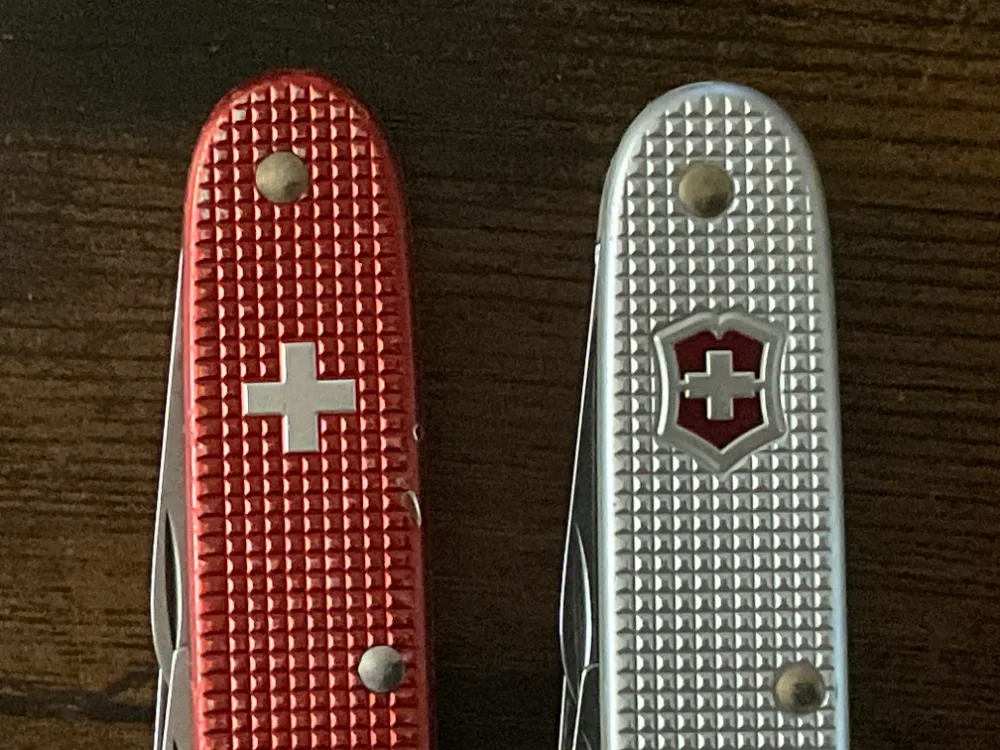
Put my Rancher next to a modern silver Alox model and the first thing the eye finds is the emblem. Mine wears a plain silver Swiss cross, no text, no border. Its neighbour wears the modern Victorinox shield. Two emblems, one inch apart, two eras of manufacture in a single frame.
Victorinox publishes no official production dates for these knives, so dating one is collector's work: you triangulate between independent markings, each acting as a floor or a ceiling, until the window narrows. Applied to this knife, the markers stack cleanly.
The blade stamp sets the floor, around 1975. My Rancher's blade reads Victorinox, not Elinox. The Elinox marking was used from 1957 to 1978, but on Alox knives it disappears around 1974. A red Alox Rancher stamped Victorinox is therefore posterior to the Elinox era: it cannot reasonably predate the mid-seventies.
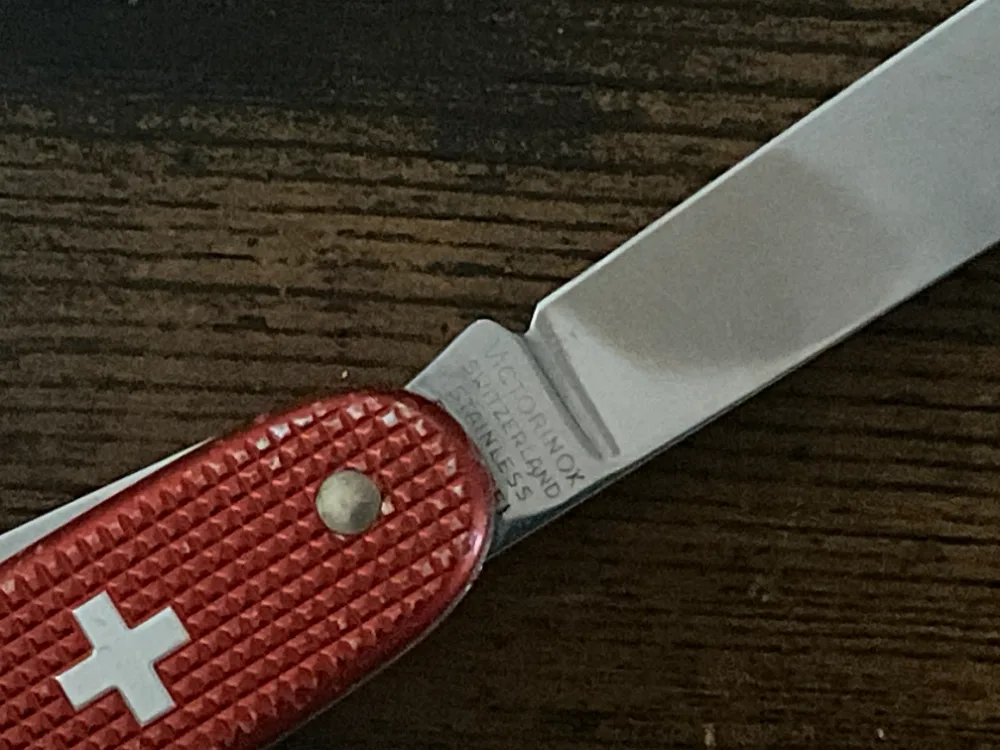
The blade stamp also sets the ceiling, around 2005. The four-line tang stamp reading Victorinox / Switzerland / Stainless / Rostfrei was in use from about 1975 to 2005, after which Victorinox switched to the modern "Swiss Made" wording. On my knife the ROSTFREI line is clearly legible on the tang, which anchors the stamp exactly to that period: this knife left Ibach before 2005, and after the Elinox years.
The emblem closes the window, around 1999. According to SAKWiki, the Pioneer family carried the plain Swiss cross emblem until roughly 1999, after which Victorinox generalised the modern shield-and-cross logo. On the Rancher specifically, two identifiers are listed: 0.8140.20, red Alox with the Old Cross, and 0.8140.26, silver Alox with the modern shield, the configuration still sold today. My knife bears the shieldless cross, so it predates the switch.
One further detail refines the reading. Certain knives from the mid-1970s and earlier carry the Victoria name with the crossbow emblem on the spine of the large blade. On mine, the spine is blank: no Victoria, no crossbow. That absence rules out the earliest end of the range and pulls the knife away from the seventies altogether.
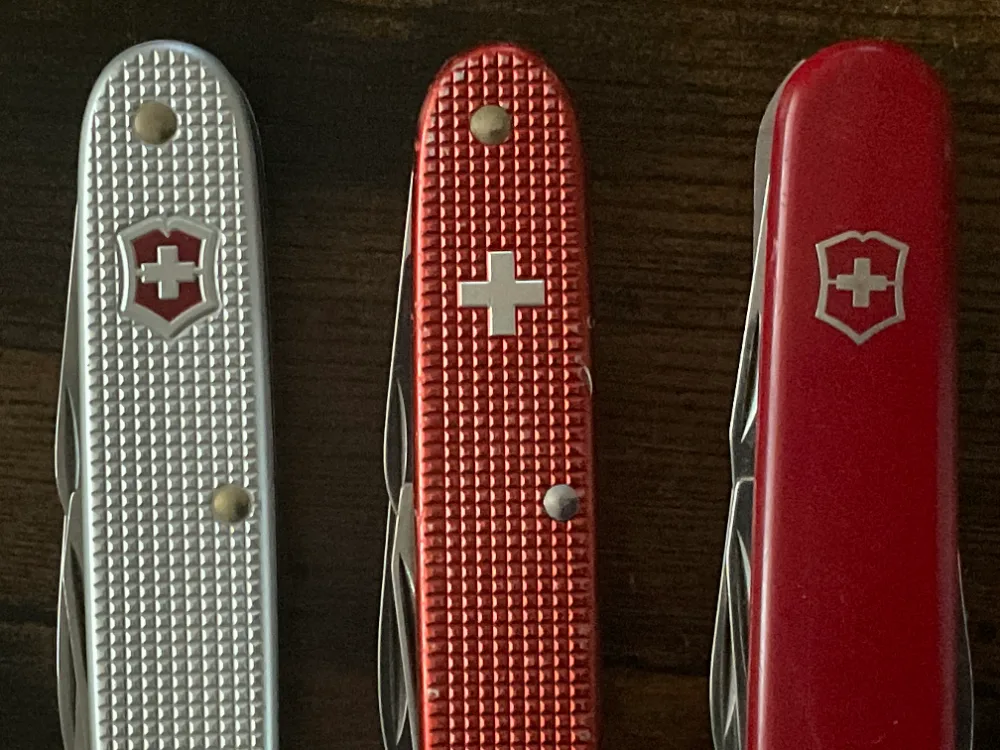
Stack the markers and the arithmetic is elegant: after Elinox (post-1975), stamped Rostfrei (pre-2005), wearing the Old Cross (pre-1999), with a clean spine that dismisses the mid-1970s. Everything converges on the 1980s or early 1990s as the most probable vintage, the era of nickel silver liners and plain cross scales. That is an estimate, not a registry entry, but it is the best the evidence allows, and the evidence is unusually cooperative.
Then the livery itself was discontinued outright: the red Old Cross Rancher (0.8140.20) is no longer made and can only be hunted. The collector's gravity around the family confirms the rarity. A black Alox special edition of fifty numbered pieces appeared in May 2011, followed by a bright green run of fifty knives in March 2012, each blade numbered on the format nn/50. Scarce runs, numbered blades, a retired emblem: the Pioneer family inspires this behaviour because it is the soldier's bloodline, provenance you can hold in one hand.
And the years show honestly. The red anodising is worn at the high points of the ribs, the silver aluminium glinting through where pockets and hands have rubbed it for decades. On Cellidor, the same wear reads as damage. On this knife, it reads as service. Scraped anodised aluminium is the field jacket of knife scales: it only looks right once broken in.
III. A Short History of the Alox Family
The Alox line is not a product range; it is a dynasty, and its chronology is worth knowing before any purchase.
Victorinox introduced the Pioneer range in 1957, red aluminium-handled knives derived from the military Soldier's knife pattern. The design proved so sound that the company based the new Swiss Soldier's Knife of 1961 on it, with red aluminium handles; the Swiss Army received its first delivery in June 1962. Between 1960 and 1961, no Victorinox shipment reached the army, Wenger producing the former model in the interim.
Production epochs read like stratigraphic layers. From 1957 until about 1984, the liners and the keyring spacer were made of brass; Victorinox then switched to nickel silver, though late brass samples exist past the official date. The earliest Pioneers lacked the engraving panel on the bottom scale and carried an original triangular awl. The family was long nicknamed Sturdy Boy, and even the Pioneer series as a whole answered to that name well into the 2010s, so renowned was its toughness.
The branches of the dynasty followed: the Cadet and the Farmer for wider audiences, the Electrician, the Harvester, the Pruner, and the Rancher, each swapping one tool on the same two-layer skeleton. The yearly limited editions and heritage reissues of today all descend from those 1957 red-handled pioneers.
IV. Alox vs. Cellidor: Metal vs. Plastic
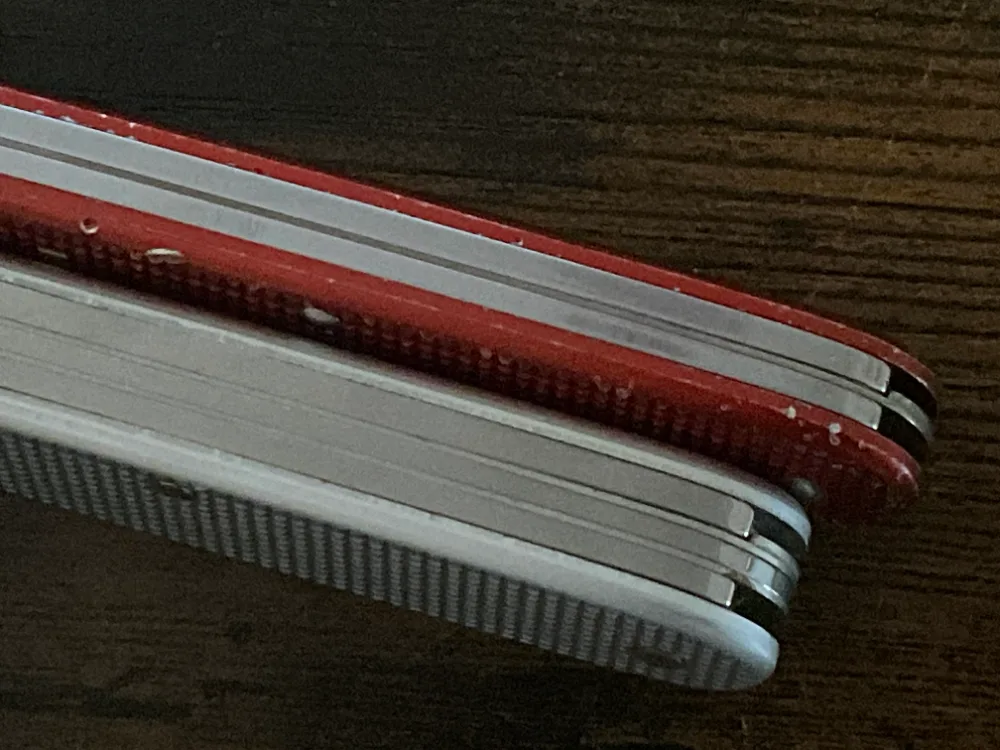
Lay a silver Alox with the modern shield, my red Rancher with its flat silver cross, and a red Cellidor in one row, and the difference announces itself before the mind names it: one machine-brushed, ribbed, mechanical; the others moulded, glossy, domestic. Put the Rancher beside a white Cellidor model, both closed, and the finding repeats.
My verdict has hardened over the years, and I will not soften it here.
Cellidor is plastic. Moulded cellulose acetate, glossy and cheerful in the shop, and that is the last good day of its life. It scratches to an ugly white with the first week of pocket carry. It chips at the corners. It cracks around pivots and rivets under any real torque. The glossy finish clouds, yellows and wears into a sad matte, and the decades are not kind to it: lift any thirty-year-old Cellidor knife and the scales look tired in a way aluminium never does. Cellidor exists for one reason, manufacturing cost, and its virtues, lightness, bright colours, room for tweezer slots, are conveniences, not strengths. It is civilian furniture, dressed for the desk drawer.
Even if Cellidor scales were introduced in 1937, to me they mainly symbolize the excessive craze companies had for plastic in the 1980s, at the expense of quality, durability and our planet.
Alox is metal. Stamped aluminium, anodised, ribbed so the hand grips it with wet rope in the palm or frost on the fingers. It was the material of soldiers, and it behaves like it. Scratches become patina. Wear becomes character. Decades of pocket carry improve the finish rather than humiliating it. The scales contribute rigidity to the whole frame instead of merely decorating it, which brings me to the next point.
And the difference is not confined to the scales. The blades and implements of the 93 mm Alox knives are built thicker and stiffer than their 91 mm Cellidor equivalents. Open the two side by side and the Rancher's large blade shows a visibly heavier spine than its thinner Cellidor counterpart. The springs hold their tension for decades, and the whole tool set inspires a confidence in hard use that the plastic-handled knives never earned. The 93 mm Alox is not a premium dress on the same knife; it is a tougher knife, period.
Consider the flat screwdriver. On the Rancher I use it routinely as a short lever: lid of a stubborn tin, nail head, warped slat, whatever needs a few millimetres of controlled persuasion. Try the same move on a Cellidor knife and listen to the scales complain; torque travels straight into moulded plastic held by rivets, and the result is the cracked corner every veteran of red-handled knives has seen. The Alox frame accepts the abuse because the metal scales brace the assembly like a clamp. That single gesture, pry with confidence, summarises the whole difference between the two families: one was drawn for the field, the other for the display cabinet.
V. Against the Swiss Army 7: The Saw Question
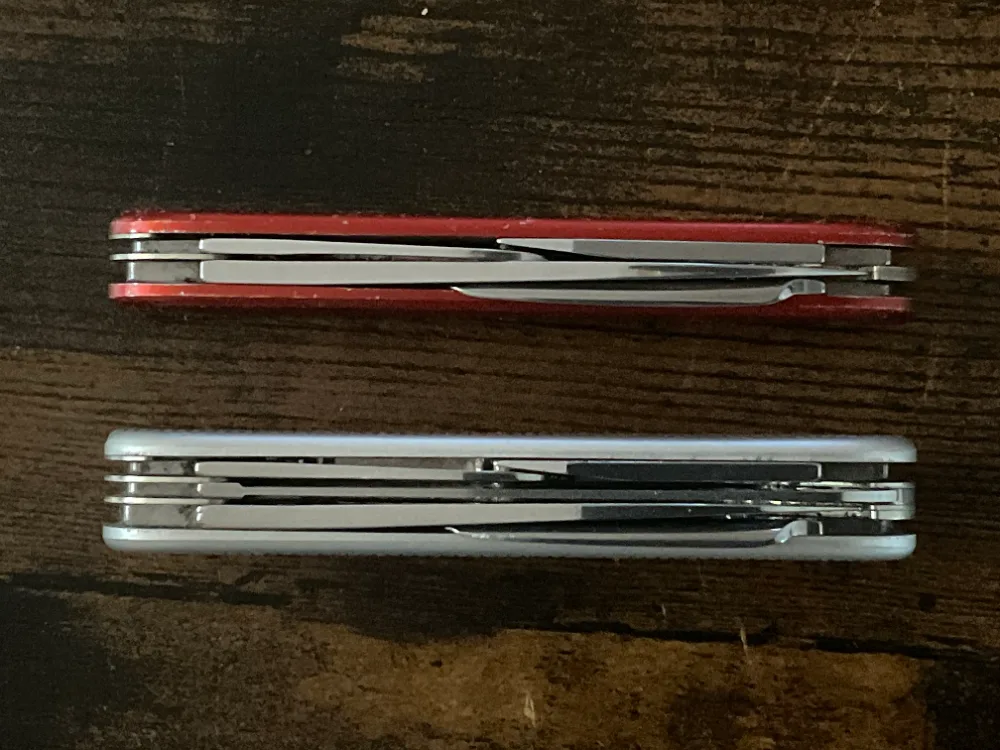
The fair comparison is the current Victorinox Swiss Army 7 Alox, reference 0.8150.26, listed on victorinox.com. Closed, lying red against silver, the Rancher's leaner silhouette is plain to measure.
On paper, the Swiss Army 7 reads like a Pioneer Rancher that swallowed a wood saw. It carries the large blade, the pruning blade, the cap-lifter with wire stripper and the reamer, then adds a full-length wood saw as its seventh function, in a silver Alox frame about 14 mm thick and 84 g on the scale. Victorinox pitches it for gardening and the outdoors, and the pitch is sincere. The saw is a proper double-rowed tool that would build a campfire without drama.
I grant the saw its due: the Swiss Army 7 is a fine knife, and there is real virtue in a genuine two-layer tool with a wood saw. But my arguments are elsewhere. On the trail, a three-layer knife is markedly less pleasant in the pocket than a two-layer one; the extra layer adds width and weight exactly where a walking pace punishes them most. In my daily urban life, the saw is the tool I need least of all. When camping is on the agenda, I take in addition my Victorinox Ranger Wood 55, with its wooden scales and a true saw, the largest this maker has ever fitted to a pocket knife, which answers the question far better than a 93 mm compromise ever could. And the Swiss Army 7 remains permanently in the catalogue, which robs it of any exceptional character. The Rancher, discontinued in its Old Cross livery, is a knife you have to hunt for.
VI. The Missing Ring, No Longer Matters
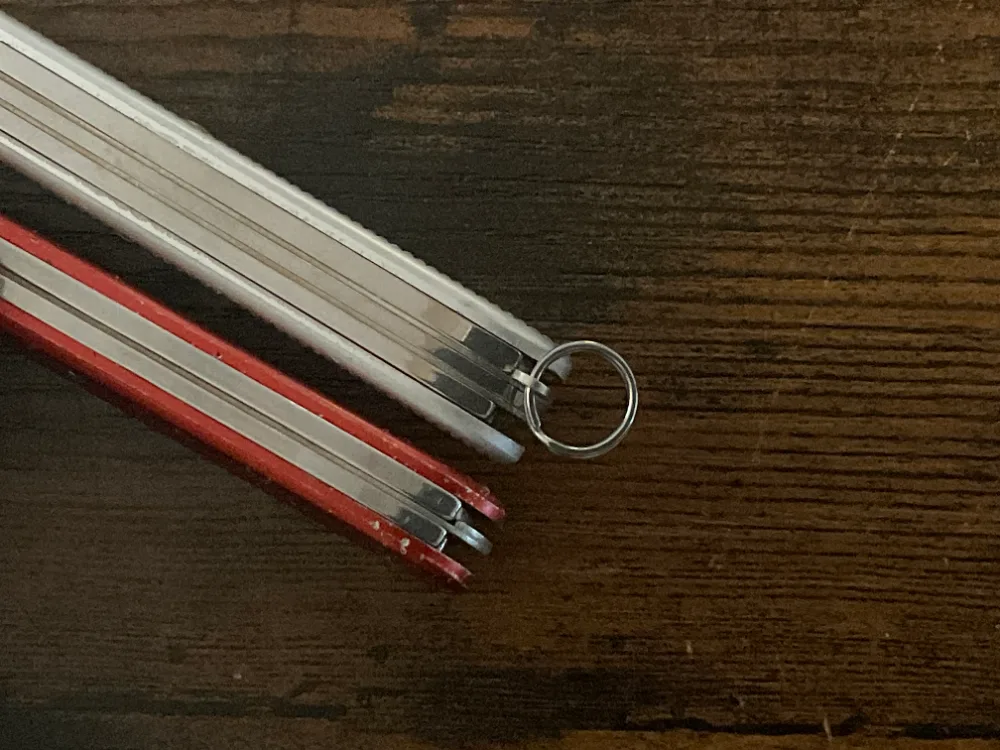
For years, the Rancher's single omission vexed me: it has no keyring, no shackle, no lanyard point, unlike the standard Pioneer, which nearly always wears its split ring. The absence becomes almost provocative next to a Cellidor knife, whose chrome split ring catches the light at the end of the scale while the red Alox ends in bare, rounded, ringless aluminium. A knife without an attachment point refuses to be tethered. It lives loose in a pocket or not at all.
But then I changed my mind. Mainly because the laws forced me to. In France, carrying a knife on one's person without legitimate reason is prohibited: a pocket knife is widely perceived as a hand weapon, whatever its modest size. Transporting one, stowed in a bag, is merely tolerated, resting on that same perception and on the good judgement of whoever inspects the kit. My Rancher therefore lives in a small EDC pouch at the bottom of my satchel, permanently, alongside the rest of the everyday kit. It travels with me everywhere; it is simply never carried on me.
The irony pleases me. A soldier's knife, denied its shackle, kept like provisions in a kit bag: closer in spirit to the field packs of its ancestors than to the keychains of its cousins. The ring I once mourned would have tempted me into precisely the habit the law forbids. The Cellidor can keep its ring. Mine has no need of one.
VII. Final Thoughts
What is the ultimate Swiss Army knife? Not the one with the most tools, nor the newest. It is the one whose form you can justify, whose history you can trace, and whose presence in your pack you never regret. A red Alox Pioneer Rancher with the Old Cross is all three: a knife from the 1980s or early 1990s, from a dynasty founded in 1957, dressed in working metal instead of office plastic, lean by design, discontinued in this exact livery and quietly gathering collector's gravity. The worn ribs, the flat silver cross, the honest steel tell the rest.
I searched for it because I knew what I needed. The search is over, and the knife, sawless, ringless, flawless, is in the bag, where it stays.
VIII. Leave a comment
No comments yet.