
Field note N° 07 ·
Filson 240: the Anatomy of a Beautiful Failure
And no one asked for it
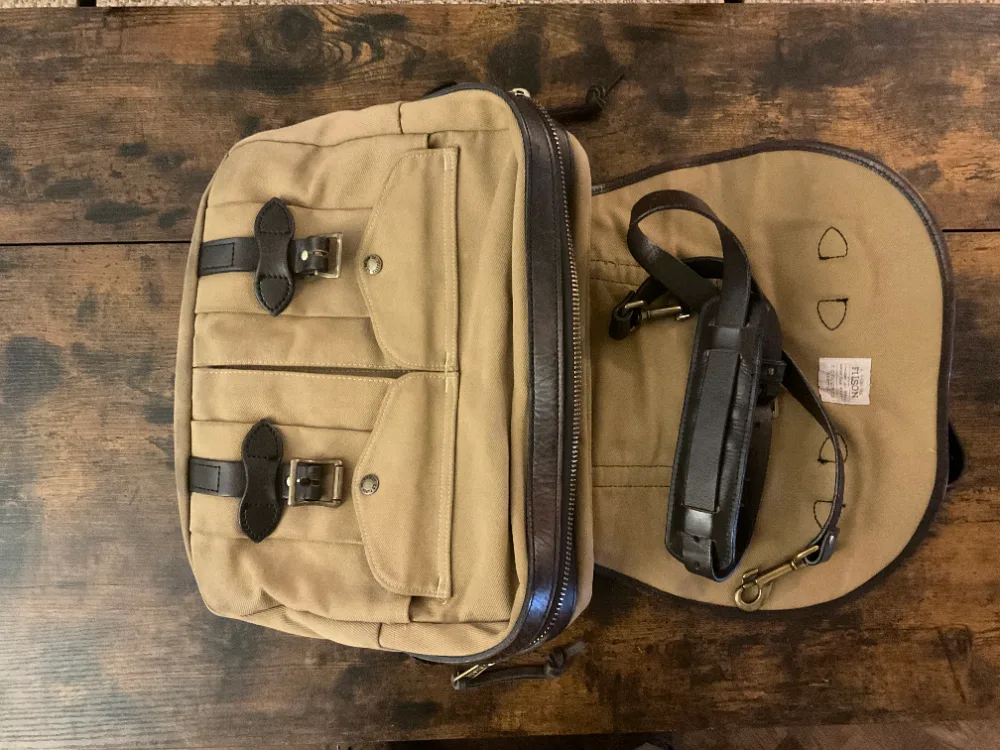
I. What is the Filson 240?— aka the Small Carry-On
The Filson catalogue has its common birds and its rarities. The Filson 240, the famous Small Carry-On, is a rarity: absent from the catalogue for years, sighted on the second-hand market only a few times each decade, and never at a bargain.
Let us be honest from the outset, because rarity and merit are two different currencies. The Filson 240 is a genuine collector's chase: a scarce piece, a chapter of Filson history, a conversation piece. It is also, I would argue after living with it, an instructive failure. A bag caught between two categories, inheriting the constraints of each and the advantages of neither. This field journal lays out what you need to know before joining the hunt: the history, the build, the measurements, and the honest reasons why Filson eventually let it go.

II. Origins: the 1991 luggage line
Contrary to a persistent myth, Filson has not always made bags. For the better part of a century the Seattle house dressed prospectors, loggers and hunters. The first genuine Rugged Twill luggage line did not appear until 1991, and it was a tight little outfit: a Small Field Bag, a Medium Field Bag, and a Small Carry-On that, in Filson's own company history, "also served as a briefcase."
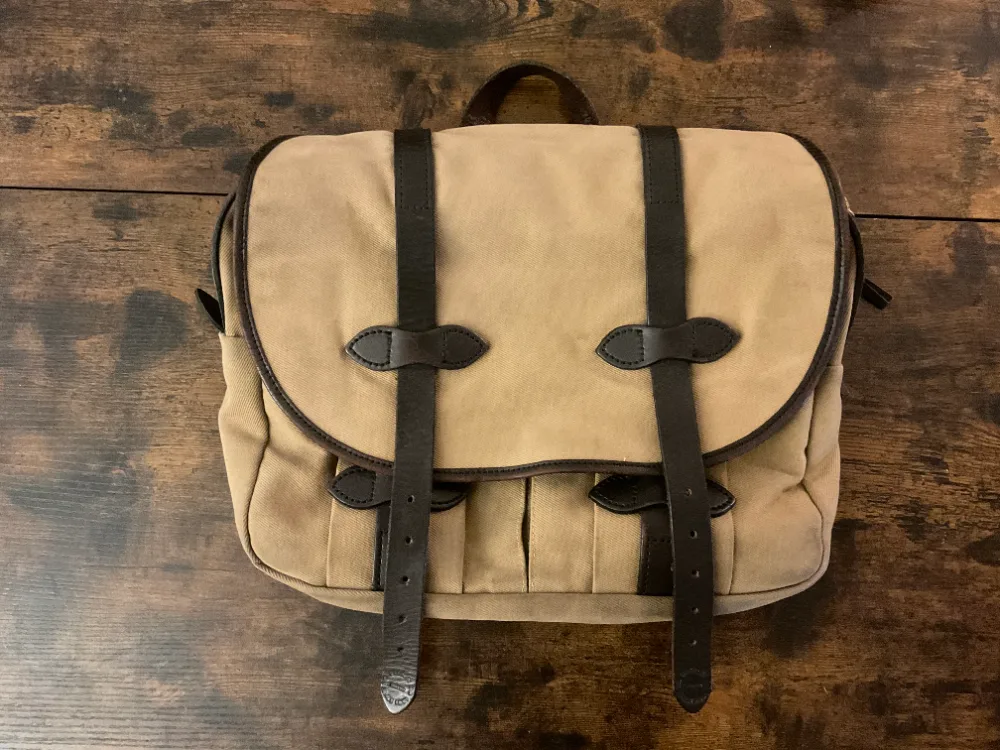
That Small Carry-On is the Filson 240. Alongside the Field Bags, it is one of the founding stones of Filson's entire modern luggage range. The line that would grow into duffels, totes and briefcases. The celebrated Original Briefcase (Filson 256), now the crown jewel of the catalogue, only arrived a year later, in 1992, followed by the "computer" variants (Filson 257, Filson 258).
One line of period catalogue copy deserves quoting verbatim: "Equally at home in the bush or aboard a jetliner." The Filson 240 was conceived as a bridge (half field bag, half briefcase). And that, as we shall see, is precisely where the trouble starts. Bridges are admirable engineering, but you have to be sure someone wants to cross.
III. The material: Rugged Twill
No ambiguity here, and this is where the Filson 240 takes no prisoners: a pure Rugged Twill bag, never offered in any other cloth. Born with the fabric in 1991, it died wearing it as its only garment.
Rugged Twill is a 100% cotton fabric of extraordinary density, woven in a 2×2 twill from two-ply and three-ply yarns. The diagonal structure of the weave makes it more pliable than a plain-weave canvas of equivalent weight. The tightness of the weave delivers tear strength measured in hundreds of kilos; the fabric Filson uses today is rated above 1,400 pounds, roughly 635 kg. After weaving, the cloth receives a surface wax treatment. It is not soaked through, hence its dry, faintly board-like hand, with no greasy residue.
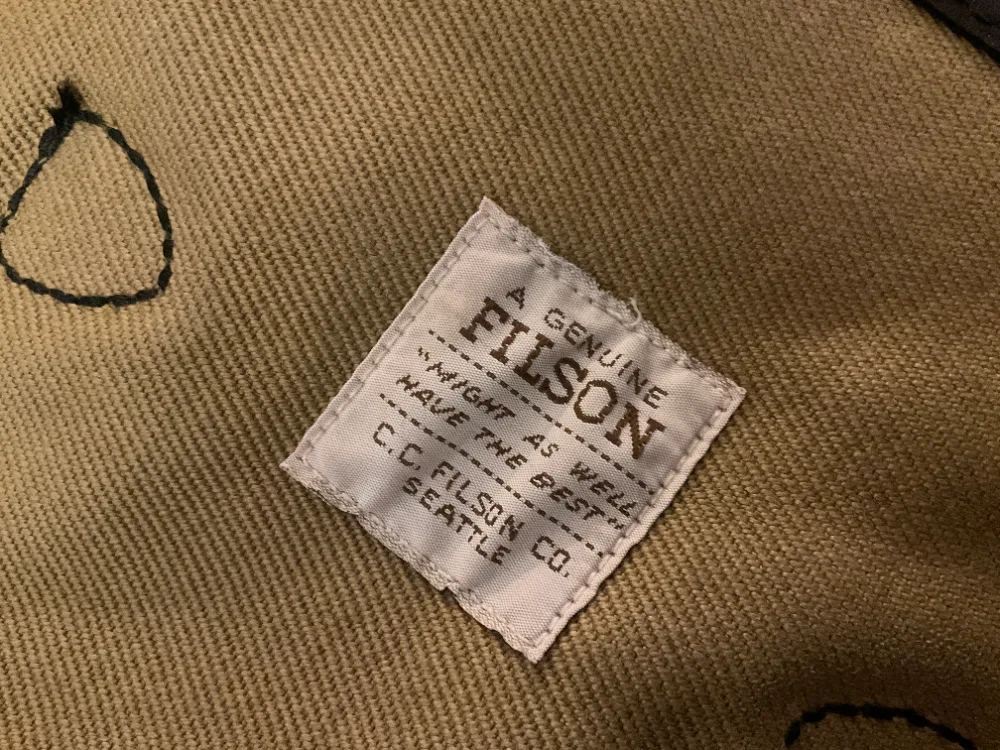
In service, Rugged Twill behaves like a good leather boot: stiff at first, then softening across seasons of use, taking the imprint of your habits. It shrugs off light rain, drinks in a sustained downpour, and patinas rather than wears out. Credit where due: the Filson 240 wears superb cloth. Everything that follows is about the tailoring, not the fabric.
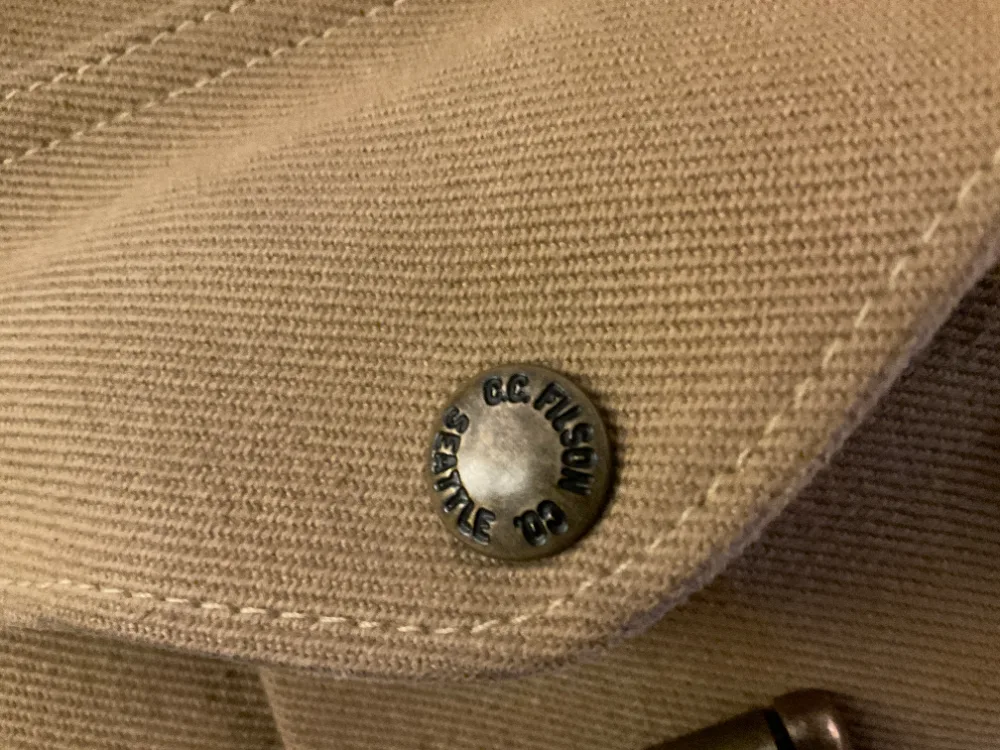
IV. Anatomy: sizing the animal
Place the Filson 240 on the bench and the first thing to note is its awkward position in the range. It is larger than the Filson 232 and smaller than the Filson 256; deliberately wedged between them. Roughly 15 inches wide (38 cm) by 11.5 inches tall (29 cm) by 5 inches deep (12.7 cm), against the Filson 232's 14 × 11 × 5 and the Original Briefcase's roomier footprint. Around 13–14 litres of volume, depending on how hard the front pockets are pushed. Empty, it weighs in the region of 1.5 kg.
In principle, that intermediate size sounds like a virtue: more space than a field bag, more compact than a briefcase. In practice, the measurements hide a twist. That extra width over the Filson 232 is innocent enough. The extra height is not (and it comes directly from the bag's defining feature).
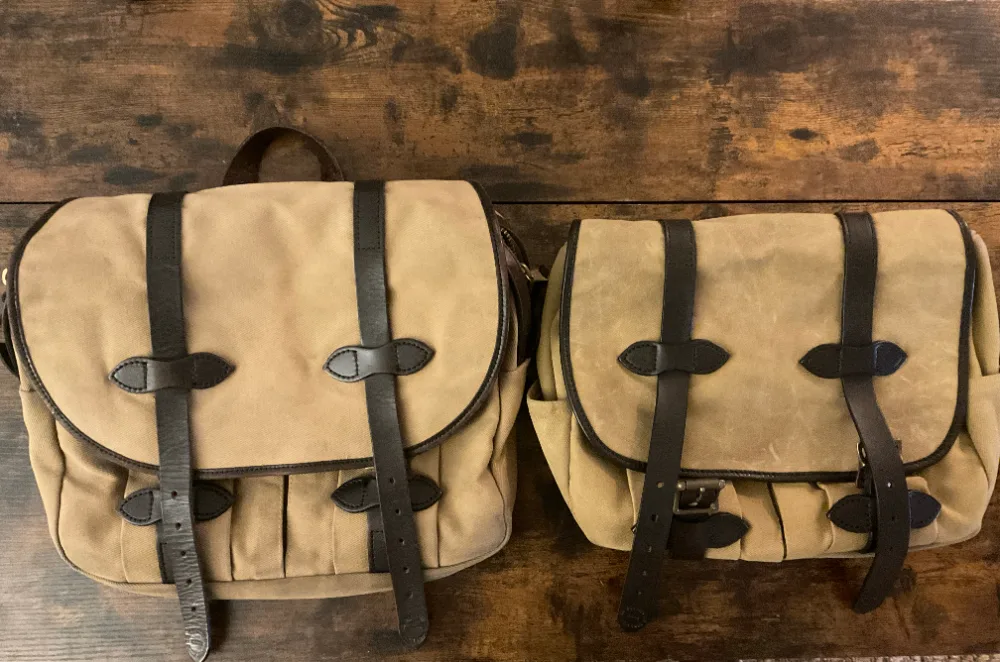
The main opening. The main compartment closes with a large solid-brass YKK zipper, concealed beneath a full-coverage storm flap spanning the whole front panel, held down by two bridle leather straps and brass buckles. On paper, zip-under-flap is the best of both worlds: sealed against rain, secured against hands. On the shoulder, it is a different story.
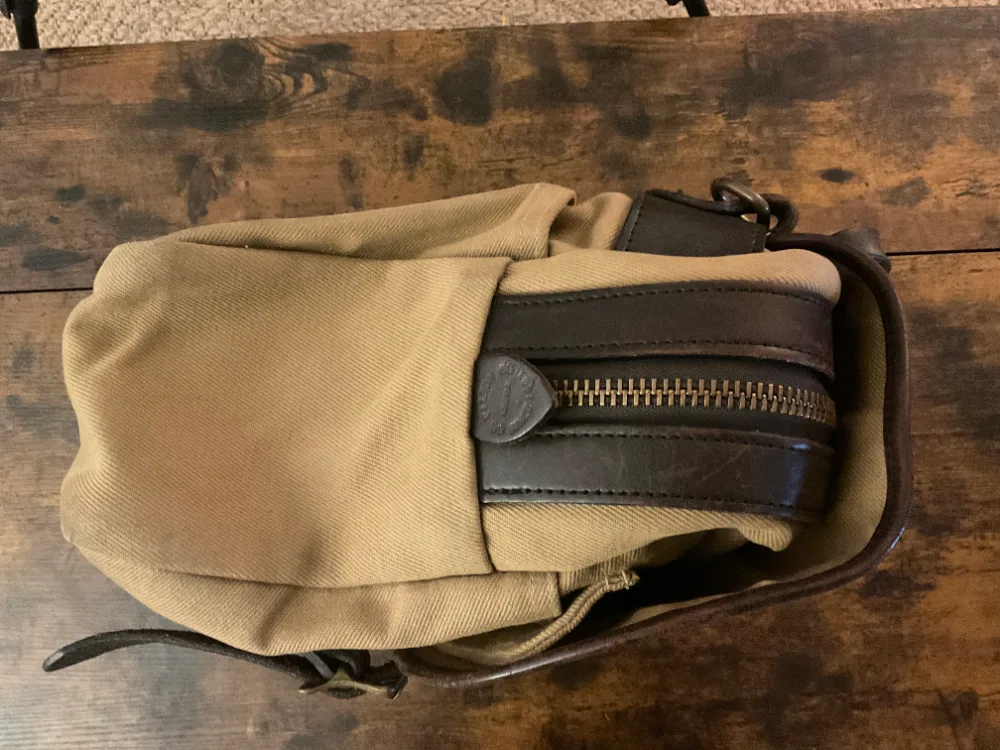
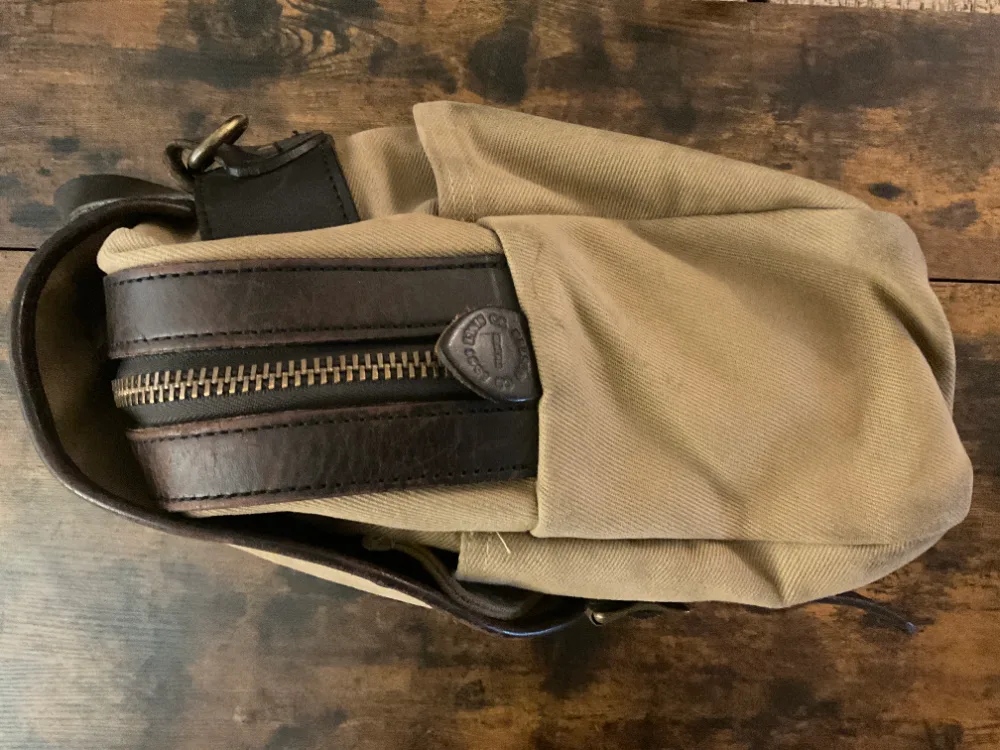
V. Zipper, or the paradigm shift nobody asked for
Here is the heart of the matter, and the honest reason why the Filson 240 divides its owners.
A field bag (a proper one, like the Filson 232) is a soft architecture. Open mouth, snapping flap, cloth that yields. In motion it collapses gently against the body; the flap drapes and settles; the whole bag moves with you like a garment. You forget you're carrying it. That suppleness is not a defect of the genre. It is the genre.
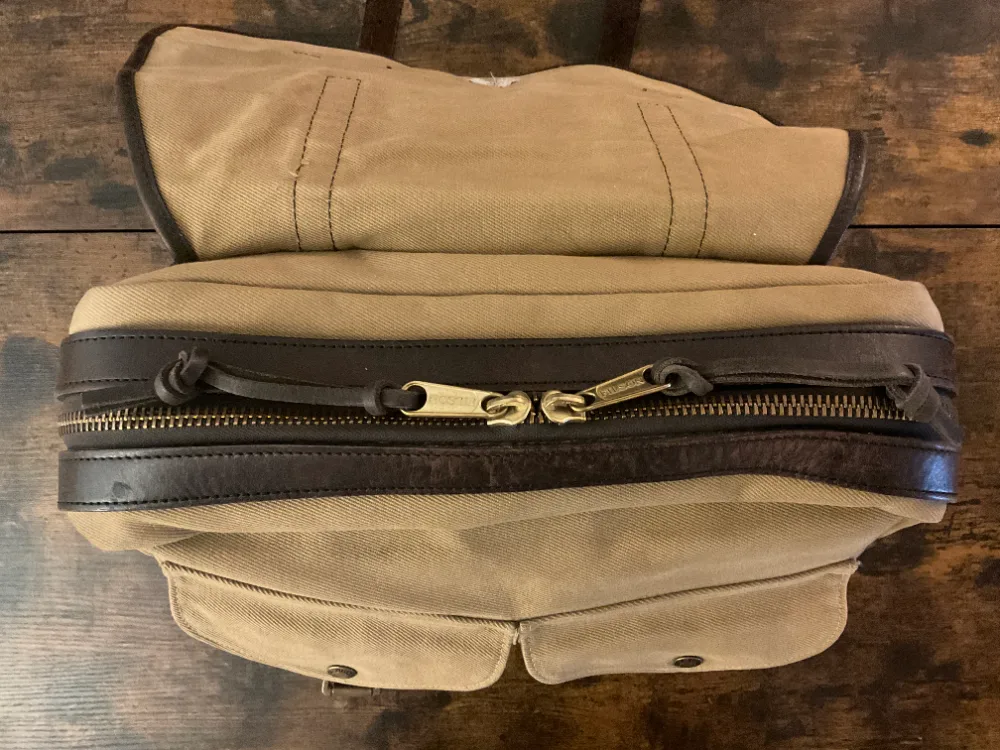
The full-length zipper changes the paradigm. To carry a zip, the bag needs a structured, dimensioned opening; which builds rigidity into the upper structure, right where a field bag should be at its softest. On my shoulder, that stiffness is maladaptive. Instead of hugging the body in transit, the Filson 240 carries itself with a certain self-important squareness; the top resisting every lean and stride.
The ripple effects compound. The zip housing adds height; this is why the bag stands half an inch taller than the Filson 232, over and above being an inch wider. And because the flap now has to clear a raised, zipped mouth, it no longer falls as gracefully as it does on the Filson 232. It sits proud, slightly architectural, catching wind and looking rather more like luggage than like a companion. Compare the two side by side and the Filson 232's silhouette reads as fluid where the Filson 240's reads as assembled.
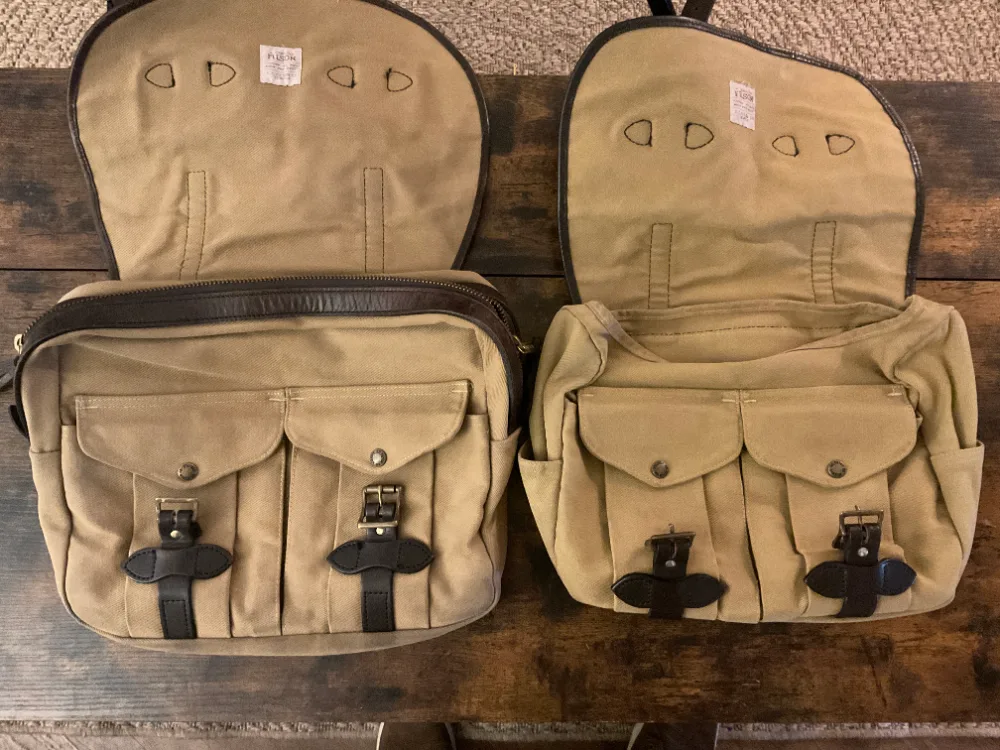
So the Filson 240 ends up a hybrid, but in the wrong direction. From the field bag it borrows the casual silhouette without the suppleness. From the briefcase it borrows the closure discipline without the organisation. It is too tall and too stiff to serve as an everyday EDC satchel, and simultaneously too spartan to replace a briefcase. Inside, a continent without borders: no dividers, no padding, no laptop bay beyond what a 13-inch machine tolerates bare against the cloth. Two expandable bellows pockets under the flap take small kit well enough. A back slip pocket is handy for flat papers, though notably shallower than on other Filson bags because the shoulder-strap anchors eat into its height. None of this amounts to a filing system; it amounts to pockets.
Hardware and attachments. Build quality itself is beyond reproach: bridle leather handle and detachable strap, sand-cast brass throughout, riveted and stitched anchor patches, doubled seams, reinforced base. Filson never cut a corner on this bag. The corners it missed were drawn on the sketching board, not on the cutting table.
VI. Filson 240 vs. 232: benchmark and deviation
The comparison forces itself, and fairness requires saying it plainly: the Filson 232 is the reference here, and it earns that status.
Same 1991 lineage, same Rugged Twill, same bridle leather, same sand-cast brass. Where the Filson 232's dimensions read 14 × 11 × 5, the Filson 240 reads 15 × 11.5 × 5; an inch wider, half an inch taller, and that half inch (as noted) is structural tax from the zipper rather than usable volume. The Filson 232's open mouth takes a hand without ceremony. Its double bottom accepts being set down anywhere without a second thought. Its flap drapes and follows the load. Squatter, more compact, better proportioned in the hand; the Filson 232 does the field-bag job so completely that it needs no defense, and I won't attempt to give it one by attacking its rival.
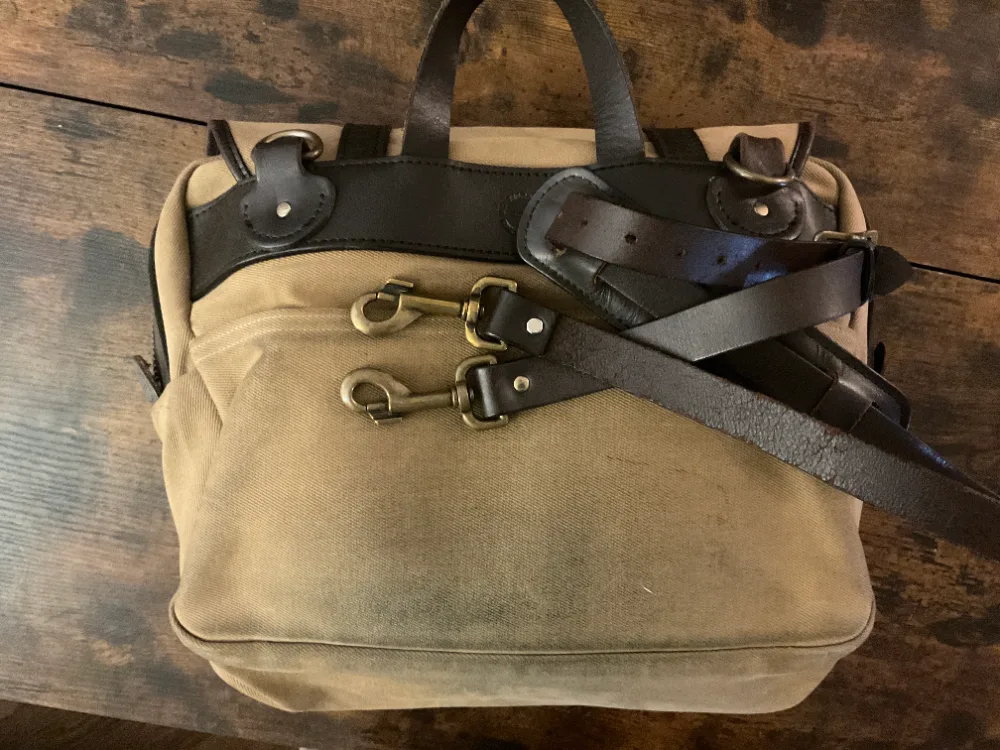
The Filson 240's counter-argument, and its only real one, is security. That full-length zip genuinely seals the contents in a way an open-mouth field bag never will, and the flap-over-zip arrangement protects papers in rain far better than a snap fastener. For rail journeys, night trains and overhead bins, it is an honest advantage. But notice what it costs: the very qualities that make a field bag a daily friend. You trade the Filson 232's yielding ease for lockable peace of mind; and I confess the trade never felt like a bargain on my shoulder.
On the second-hand market, incidentally, the pairing reads like a referendum. The Filson 232, a steady seller for three decades, is readily found at fair prices. The Filson 240 appears a handful of times a year, snapped up fast by collectors, usually above its old catalogue figure ($225 for the Filson 232, $265 for the Filson 240, early 2010s). Rarity, though, records devotion and low production runs; it does not record quality of design. The Filson 240 is scarce partly because few were made, and partly because few were ever asked for again.
VII. Filson 240 vs. the briefcases: outnumbered
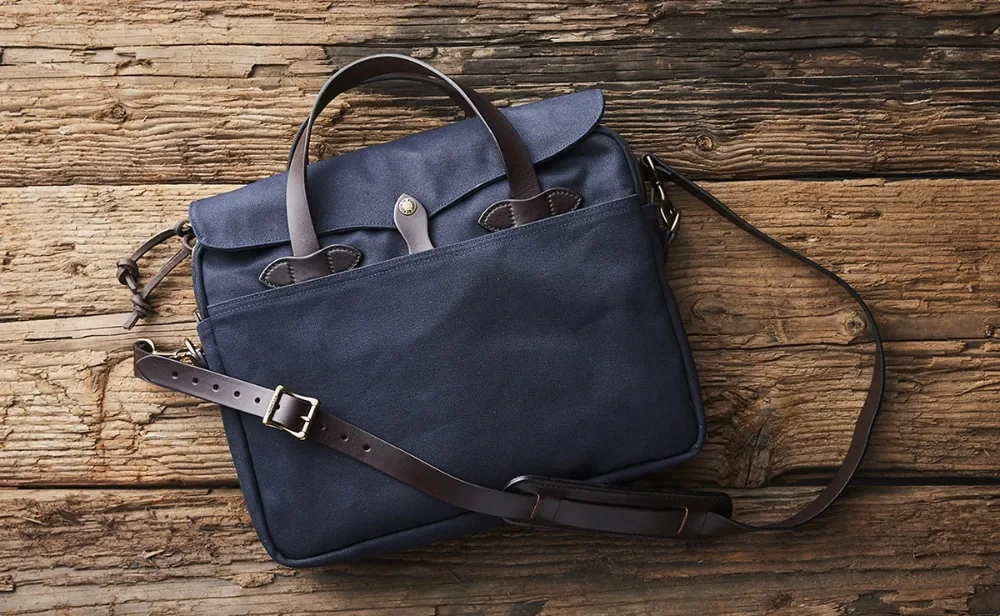
As a would-be briefcase, the Filson 240 fares no better. The Original Briefcase (Filson 256) is shallower and more compact in depth, with internal dividers, sensible external pockets, and a fifteen-inch laptop in its sights. Crucially, it is still in the catalogue: buyable new, warranted, no hunt required. Where the Filson 240 gives you a zip and a void, the Filson 256 gives you a zip and a system. The "computer" variants (Filson 257, Filson 258) go further still, with padded, dedicated compartments the Filson 240 never had. Against these, the Filson 240's briefcase credentials dissolve. Its only edge over the Filson 256 is a swagger of field-bag styling it cannot fully cash.
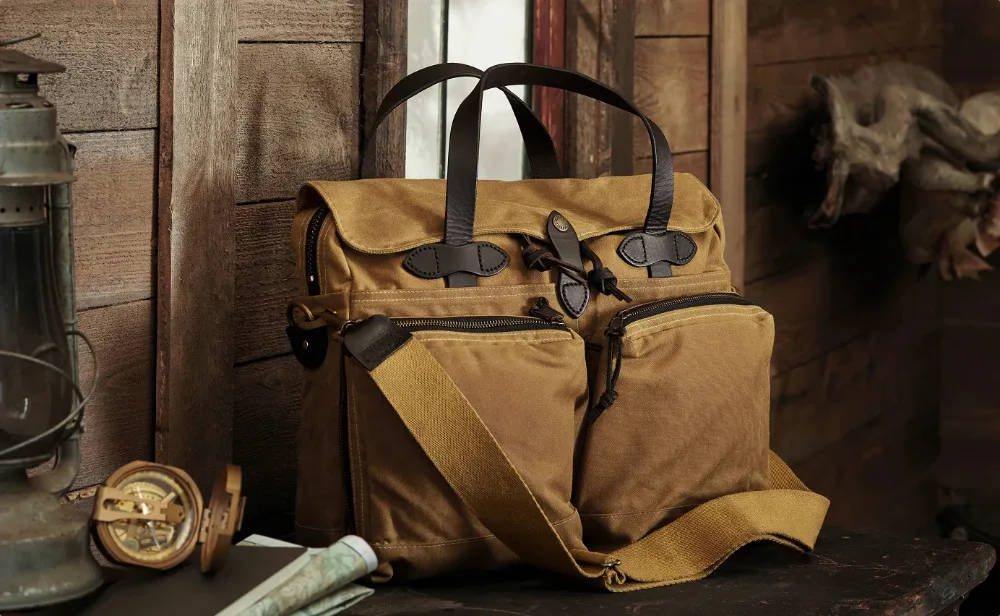
Seen from every side, then, the position is unenviable. Too stiff for a satchel. Too disorganised for a briefcase. Bigger in every direction than the Filson 232 while carrying little more; taller than it needs to be because its zipper demands headroom; with a flap that never learned to fall the way a Filson flap should.
And this is why it is entirely normal that Filson dropped the Filson 240. A maker rationalising its range does the arithmetic, and the Filson 240's arithmetic never balanced. The customers who wanted a field bag bought the Filson 232 and were happy. The customers who wanted a briefcase bought the Filson 256 and were better served. The Filson 240 answered a question the public did not ask. Its retirement is not a mystery wrapped in corporate indifference; it is a product line correcting itself. The tragic part, for those of us who cherish the quirky chapters of a brand's history, is that the correction erased a genuinely singular object: the only Filson that ever tried to be two bags at once.
VIII. Using Filson 240
A few objective waypoints to feed that paragraph. Carried over the shoulder, the bag announces its structure immediately; expect a period of adjustment if you come from softer luggage. By the handle, for short hops, it is impeccable and somehow more coherent. The Filson 240 at rest in the hand, stiff and squared, finally looks like the object it was trying to be. Use windows where it earns its keep: cabin bag for a one-night hop, document carrier through stations and airports, festival of brass at hotel desks. Beyond those, the Filson 232 wants for nothing on the street, and the Filson 256 wins the office.
Two habits worth acquiring. First, the buckle ritual: set the flap once and for all, then operate the zipper alone (undoing the straps every time is a tax nobody should pay twice). Second, the annual service: dry brushing, and a film of warm wax across the shoulders, those zones that grey first. The cloth rewards the attention; it is the best thing in the whole package.
IX. Tracking down a Filson 240
You've spotted a listing. Before you pay, run the beast through the following inspection, and through one further screen: the honest question of whether you want a rare bag or a good one.
The cloth first. Read Rugged Twill the way you'd read a bookbinding: wear at the base is a natural sacrifice zone; old water marks are part of the journey; holes disqualify. A dirty bag is not a worn bag. Cloth brushes clean and takes wax, a tear does not negotiate.
Then the leather. Bridle leather cracks at flex points after years (cosmetic, harmless). Check the junctions instead: flap buckles, strap anchors, handle. Those are the only places a Filson genuinely fails.
Finally the hardware. Sand-cast brass oxidises to verdigris, polishes by hand, never rusts. A seized zipper frees with patience. A broken slider is a cobbler's job, but negotiate; it is the bag's only mechanical organ. Given everything said above, it is also the organ that will decide your feelings about the whole enterprise. Love that zip and you will forgive the Filson 240 everything. Resent it (as I partly do) and no patina will absolve it.
On price, sellers hold the high ground, rarity being what it is. A sound 2010s example commands more than its original tag. Walk away from blurry auctions and any whisper of off-platform payment. The last, ungallant question to ask yourself at the checkout: with the Filson 232 a search away at a fair price and the Filson 256 available new, am I buying a bag, or buying the ending of a story?
X. What does it look after years of abuses ?

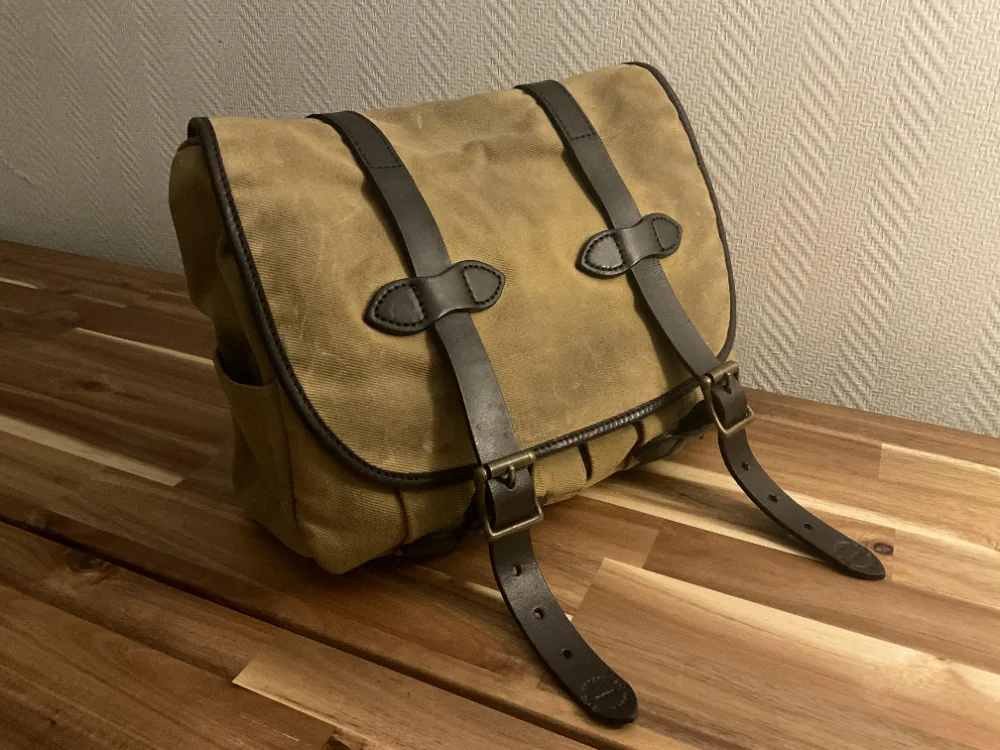
YouTuber J Ko show what the Filson 240 looks like after years of abuses. The twill develops a nice patina. That patina requires you have waxed the twill first and looks amazing. Of course you can get the same patina on the Filson 232 as shown below.
XI. Final Thoughts
The Filson 240 fails as a hybrid; that must be said. It took a field bag's soul, zipped it shut, and lost the softness in the surgery. It borrowed a briefcase's discipline and forgot the pockets. Stiffer, taller, prouder-flapped than the bag it grew beside; too angular for the body; too bare for the office. It answered a question nobody asked, and the market's answer to Filson was silence, then discontinuation. Entirely logical, entirely deserved from a commercial standpoint.
And yet. The Filson 240 remains a piece of history: a founding bag of the 1991 line, cut from peerless cloth and flawless hardware, kept alive by a small devout following precisely because it is imperfect. Collections need their flawed manuscripts alongside the first editions. I keep mine the way one keeps such pages: not as the best object on the shelf, but as the most instructive one. You don't buy a Filson 240 because you need a bag. You buy it because you already own the good ones, and the archive wants its cautionary tale.
XII. Leave a comment
No comments yet.