
Field note N° 05 ·
A review of the Filson 232 - Medium Field bag
A bag to work like captain and to play like a explorer
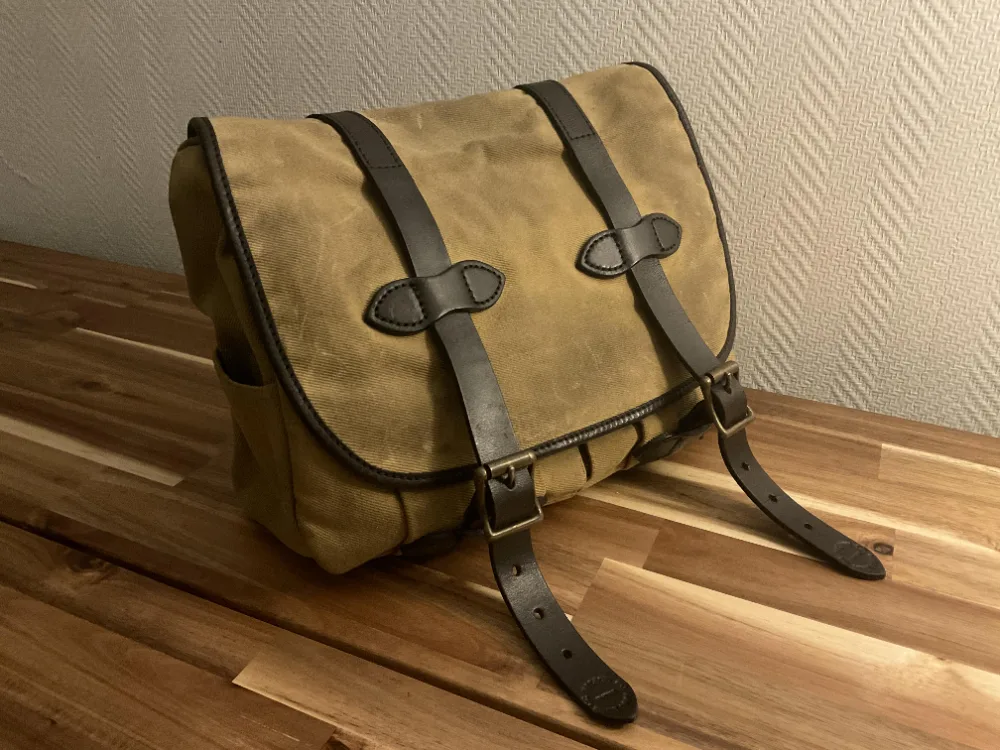
Some bags merely carry things. Others accompany journeys. The Filson Medium Field Bag, reference 232, belongs firmly to the second camp. To understand why, one must travel back a little further than usual: to a Seattle storefront opened in 1897 by Clinton C. Filson, trading as "Pioneer Alaska Clothing and Blanket Manufacturers." The shop stood steps from the waterfront where the steamship Portland had just landed loaded with Klondike gold. Prospectors bound north needed gear they could stake their lives on. C.C. Filson supplied it, and his gear outlasted the stampeders. Of the gold-rush outfitters, Filson is one of the very few still standing.

The Field Bag is a much later chapter of that story, but it inherits the logic: build a thing properly, or not at all. Introduced in 1991, it belonged to the very first Rugged Twill luggage collection, alongside a Small Field Bag and a Small Carry-On that doubled as a briefcase. The 232 has now spent more than three decades in continuous service. Filson calls its bags "unfailing goods"; the 232 is among the earliest proof.
I. A Hybrid Silhouette
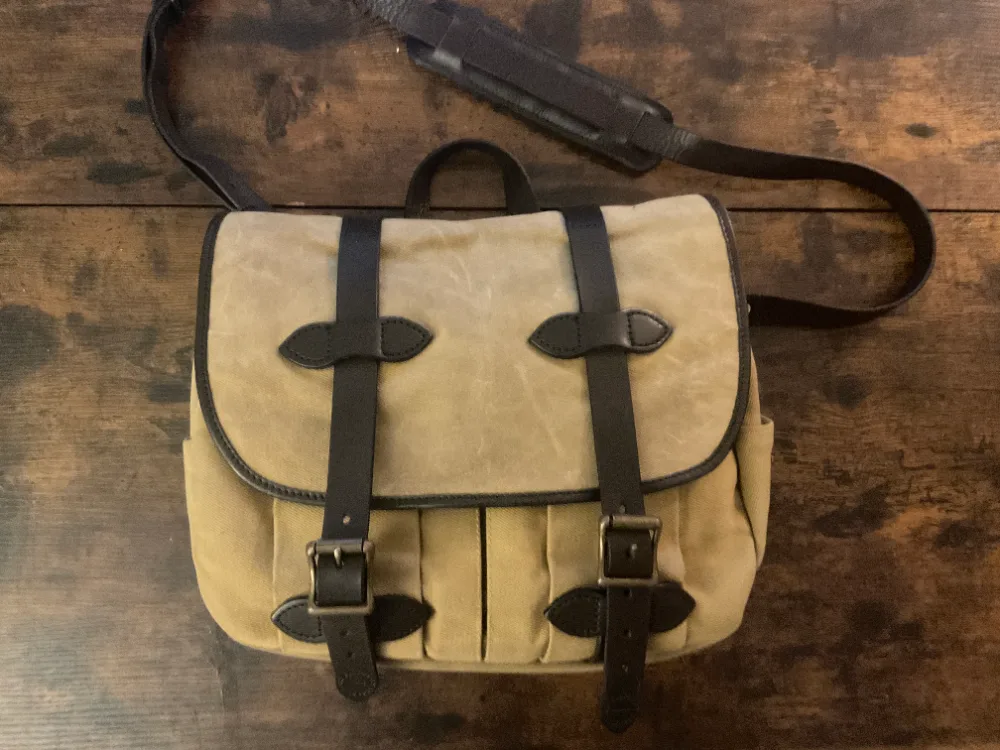
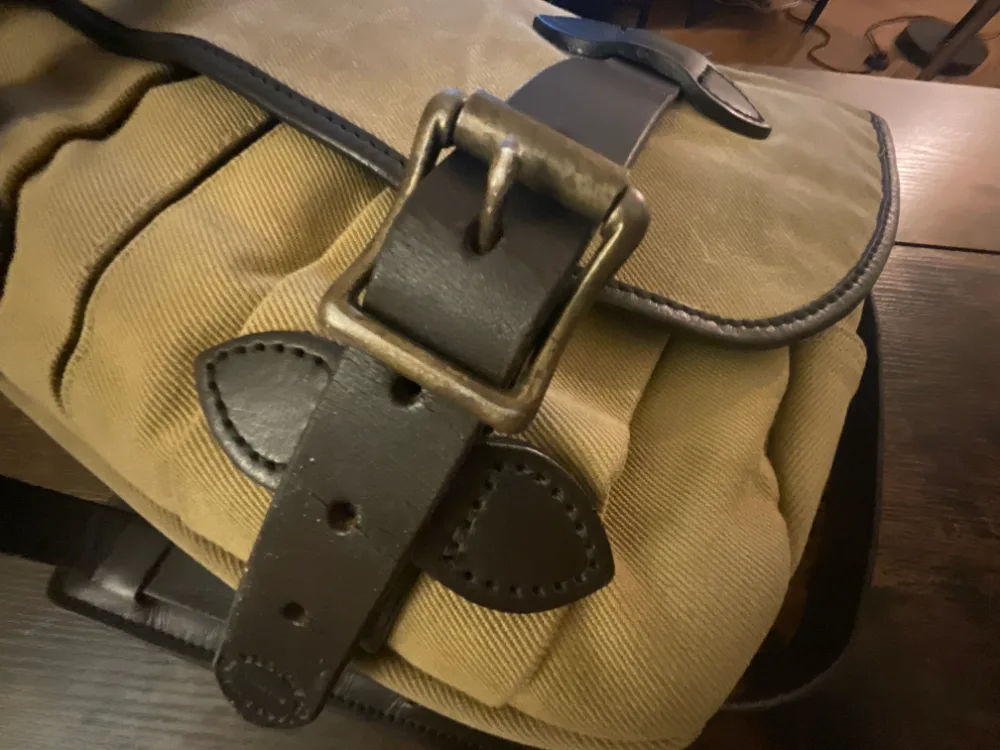
At first glance the Filson 232 shares the visual DNA of its elder sibling, the Small Carry-On (Filson 240), with which it has long been confused. But where the Filson 240 is a closed vessel (sealed by a double closure: storm flap over zipper), the Filson 232 opts for radical simplicity. No zipper across the main compartment. Just a broad bridle-leather storm flap, held by two straps and solid brass buckles, shielding the opening from the weather. We'll have an in-depth look at the Filson 240 here on the Lodge later on.
That missing zipper is no oversight. It is a design decision, and one that simplifies the bag. The twin bellows pockets sit below the flap, reachable without undoing the straps (ideal for a passport, a field notebook or a phone). With no secondary closure blocking the interior, the main compartment swallows whatever the day demands: a camera cube, a folded map, a flask. This hybrid nature defines the bag. Neither a rigid office satchel nor a mere rucksack, it is a field tool, adaptable by instinct.
II. Choice of Fabric: Rugged Twill or Tin Cloth?
Filson keeps two textile traditions alive, and the discerning traveller would do well to tell them apart before committing. The 232 settles the matter outright: it is cut from Rugged Twill, and nothing else.
Rugged Twill, the Filson 232's cloth. A 100% cotton fabric woven in a 2×2 twill from 2-ply and 3-ply yarns. It is remarkably dense (Filson credits it with a tear strength exceeding 1,400 pounds) and resists abrasion better than ordinary canvas, while staying more supple than a plain-weave of comparable weight. Water resistant rather than soaked in wax, it demands no rewaxing: a stiff brush is maintenance enough. The cloth comes from British Millerain, the Northern England mill founded in 1880, and Filson openly admits it "scoured the earth" to find weavers capable of a fabric this tight. This is the choice of quiet endurance; the kind that crosses decades without asking for attention.
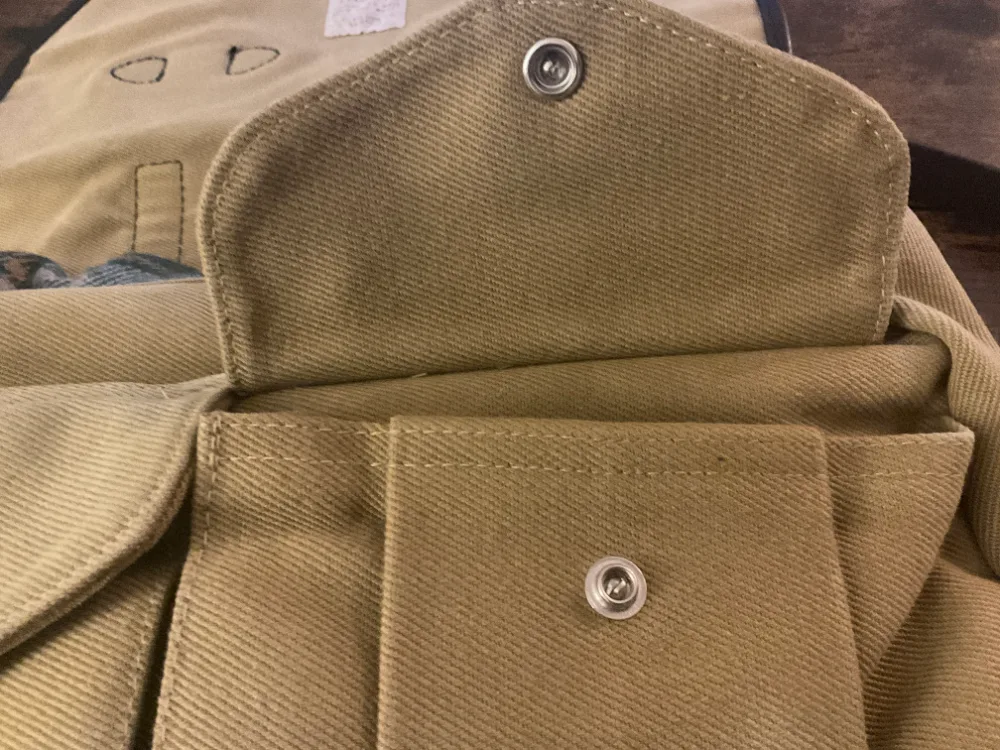
Tin Cloth, the other school. To understand what the Filson 232 is not, consider the Journeyman Backpack, its rucksack cousin. That one is built chiefly from Tin Cloth, a 14-oz canvas duck saturated with paraffin wax; the Rugged Twill is confined to the back panel and base as reinforcement. Tin Cloth carries its own origin story. In the late 1890s, British Millerain's paraffin-treated khaki drill (a fabric so durable it was issued to soldiers worldwide) reached North America through traders, and C.C. Filson seized on it as the successor to sailors' oilcloth. It became the armour of Pacific Northwest loggers and hunters: maximum water repellency, but active upkeep (periodic rewaxing), and a patina that records every squall weathered.
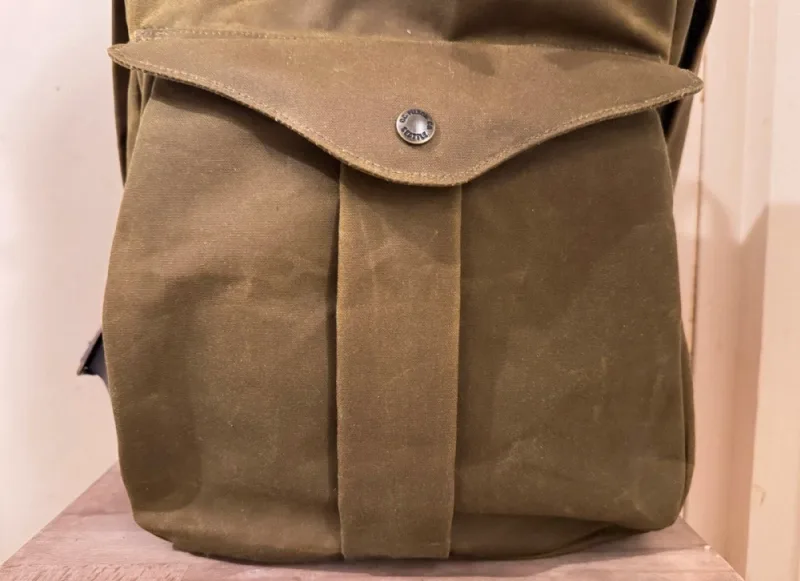
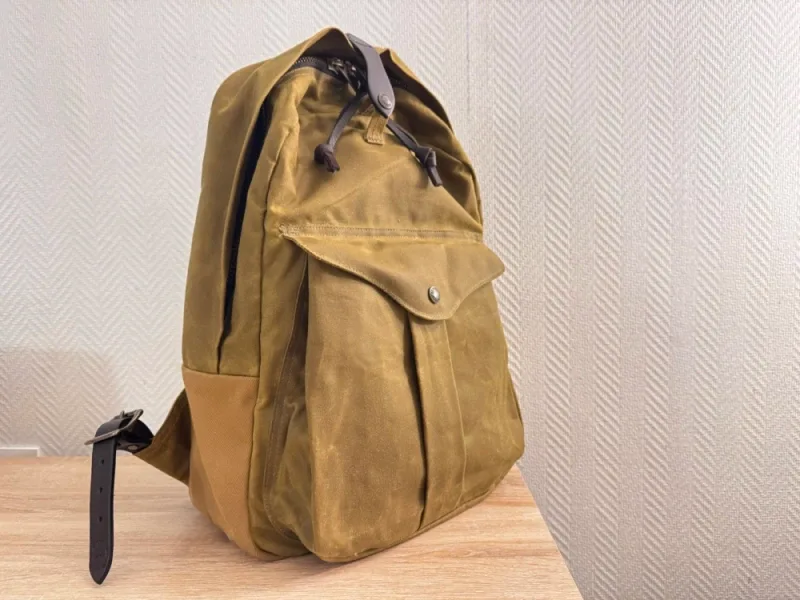
Two philosophies, then. The Filson 232 in Rugged Twill is sober and self-reliant; the Journeyman in Tin Cloth is ceremonial and scar-bearing. One is carried and forgotten. The other is carried and maintained, like a good leather object. Each traveller chooses the pact he wishes to strike with his kit.
III. The Break-In Ritual
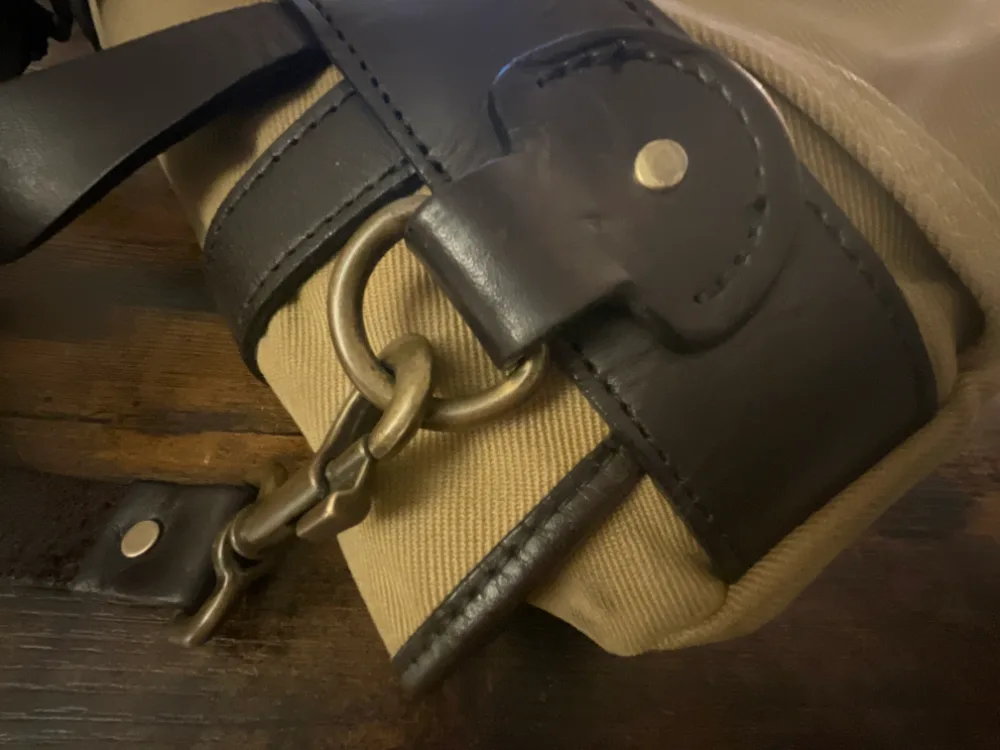
There is one more thing the catalog will not tell you: the Filson 232 arrives stiff as a wagon wheel. The bridle leather of the straps, the buckle loops, even the shoulder pad, none of it yields on the first day, nor the first week. The buckles resist threading. The flap sits proud, refusing to lie flat. Wear it cross-body on day one and the strap announces itself at your collarbone like a raw rope.
This is not a flaw. It is a covenant. Modern synthetics flatter you from the outset and betray you within the season. The Filson 232 does the opposite. It demands a fortnight of honest work (loading it, walking with it, unbuckling and rebuckling) before it concedes anything. Somewhere around the second month, the leather takes the shape of your shoulder. The straps develop a memory, and the buckles, once adversaries, become gestures. Veteran owners describe the moment with something close to affection: the day the bag stops being worn and starts being carried by you, the two of you moving as one.
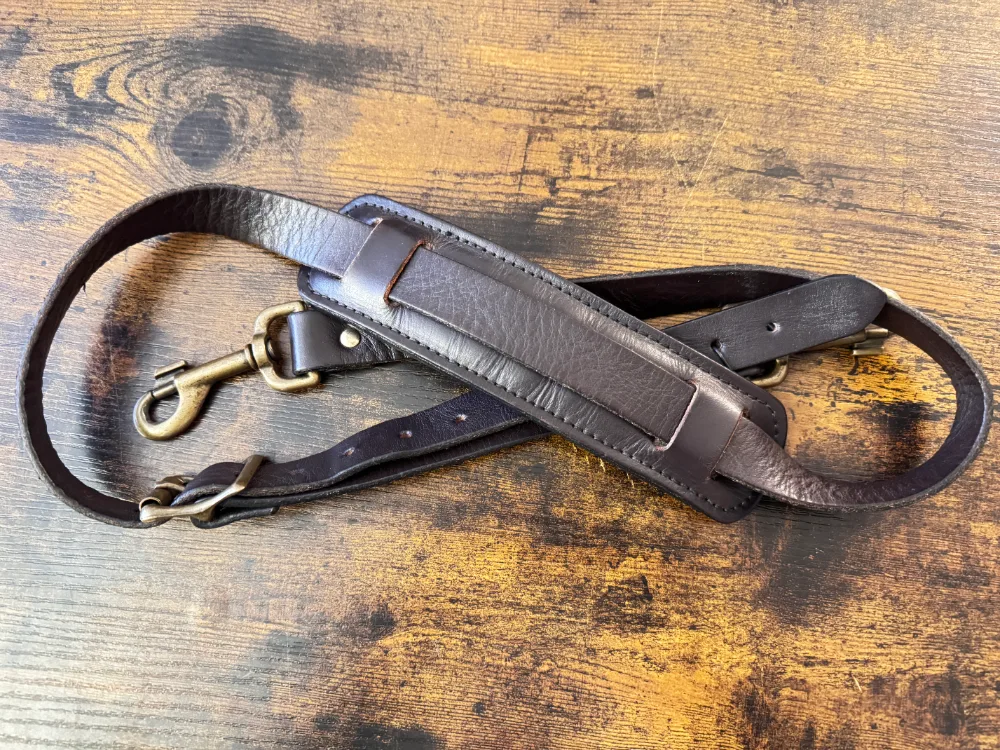
Consider it a rite of passage. The bag does not yield immediately; it waits for you to earn its comfort. On an expedition of the last century, gear was broken in like boots and horses before the trailhead was ever reached. Nothing about the Filson 232 contradicts that grammar. It is gear that remembers the shape of your life.
IV. Dimensions and Capacity: The Right Balance
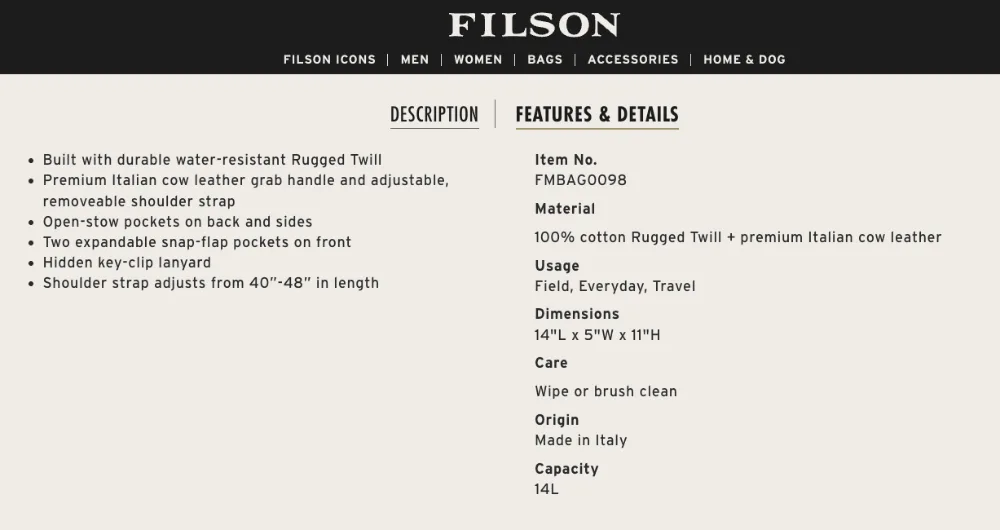
The Filson 232 measures 14 in wide, 11 in tall and 5 in deep (roughly 35.5 × 28 × 13 cm), for somewhere between 13 and 15 litres of usable volume. The figure shifts depending on whether you leave the front bellows flat or load them generously.
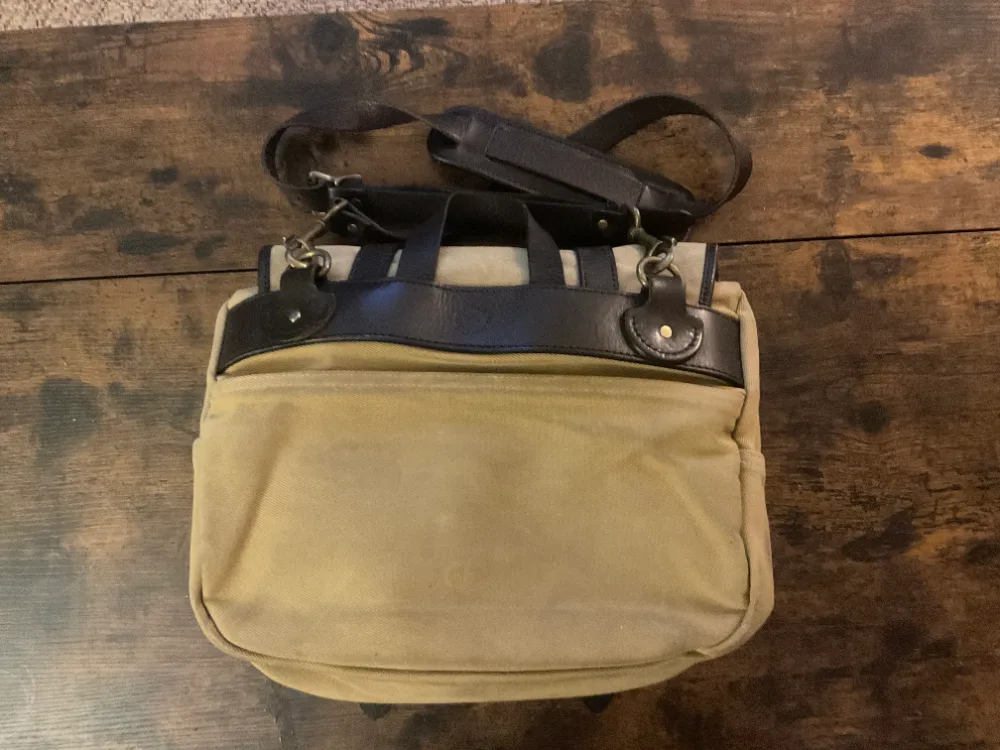
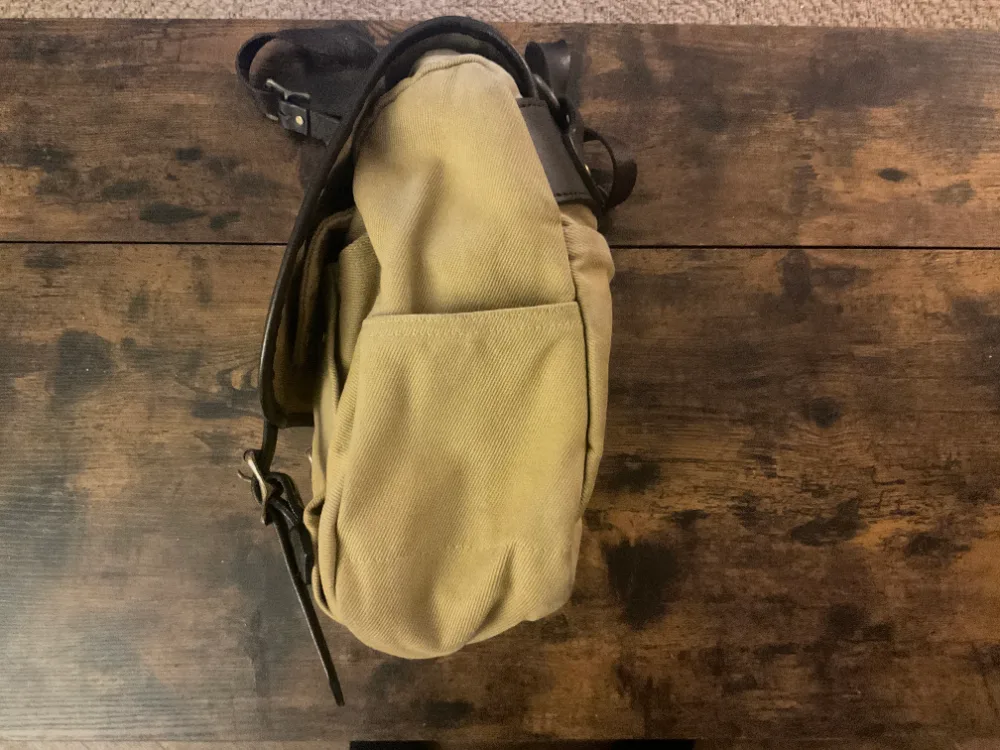
In practice it swallows a 13-inch laptop without complaint (OK rightthe rounded base makes entry a little awkward), a thick book, a light jacket and a water bottle. Around the frame, the layout rewards the methodical. A full-length back pocket on one side; two open side stow slots; the twin bellows fronts under the flap; and, on current editions, a hidden key-clip lanyard inside. The double-walled bottom protects the contents even when the bag rests on abrasive ground, and the bound interior seams are there to outlive the rest of us.
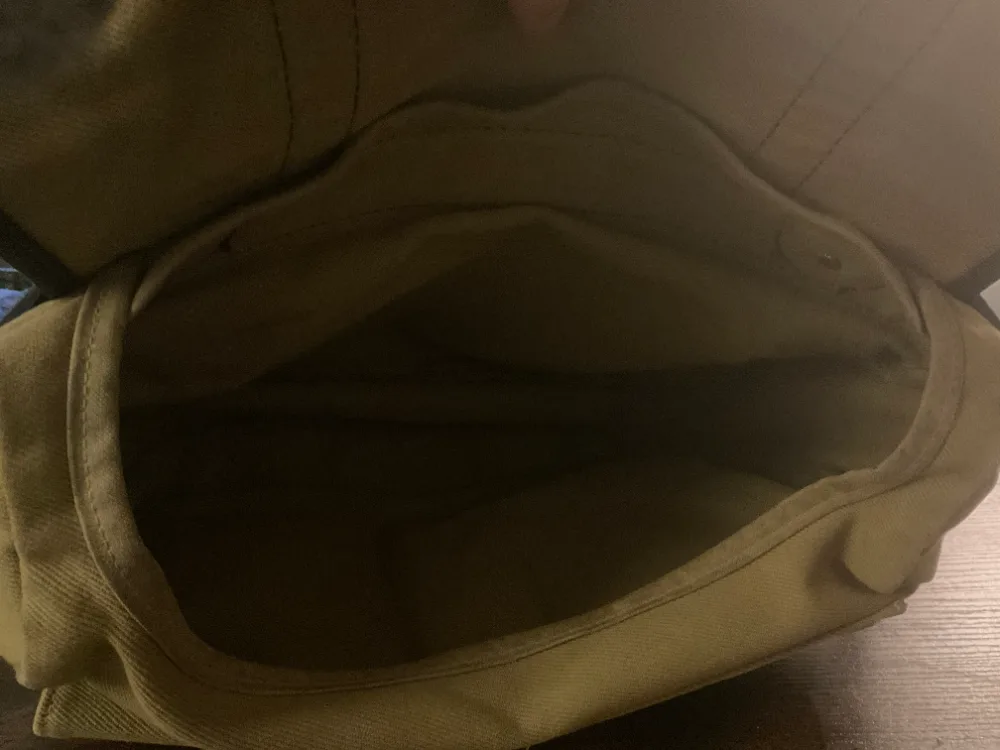
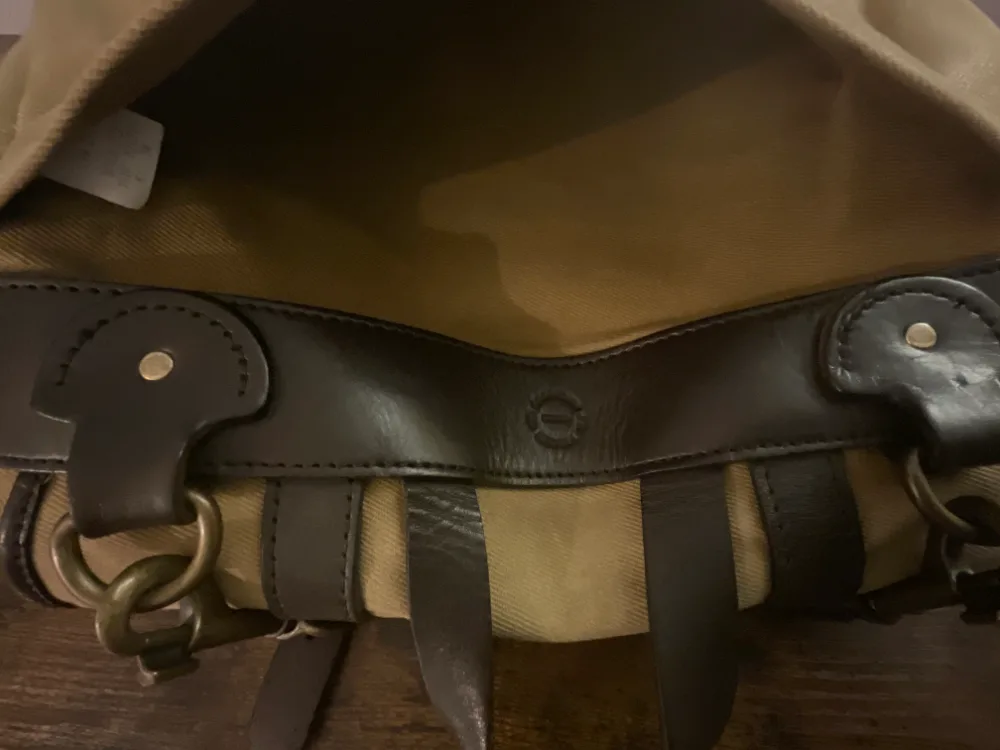
Now either you love or you hate the lack of zipper. You'll hear people say that without a zipper, should you want your belonging to be secured, then you will have to fiddle with the closing buckles frequently. And this scenario might happen more than you like, because you're not just walking around peacefully. There might be rain and wind coming. You might need to ride a bus or a subway. If you're on the beach, you may to avoided (as much as you can) sand going into the bag. If the bag is filled with groceries, some items might fall off if the top flap is not secured...
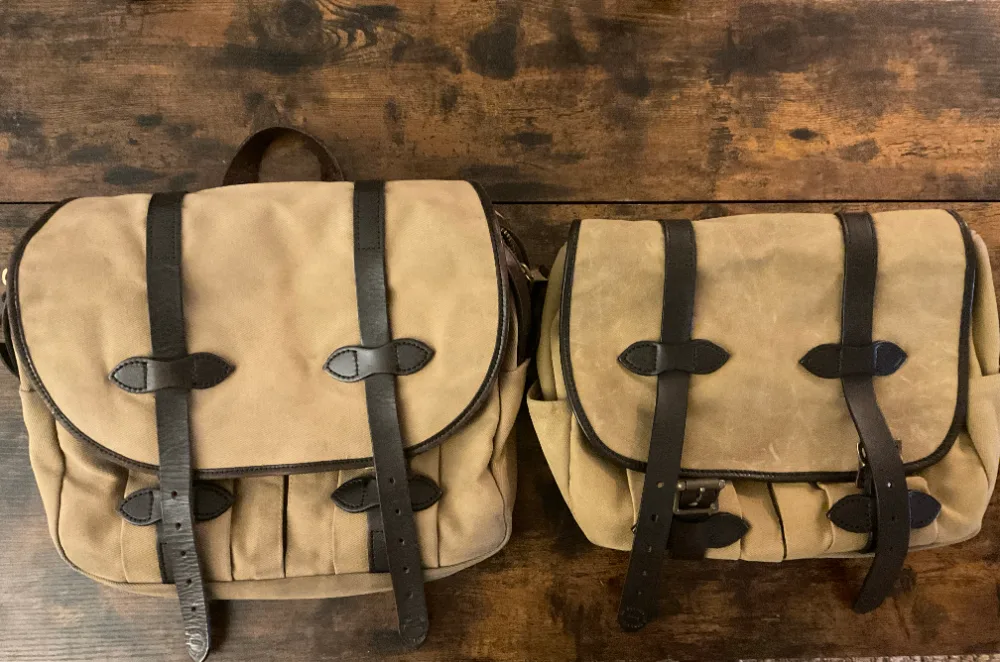
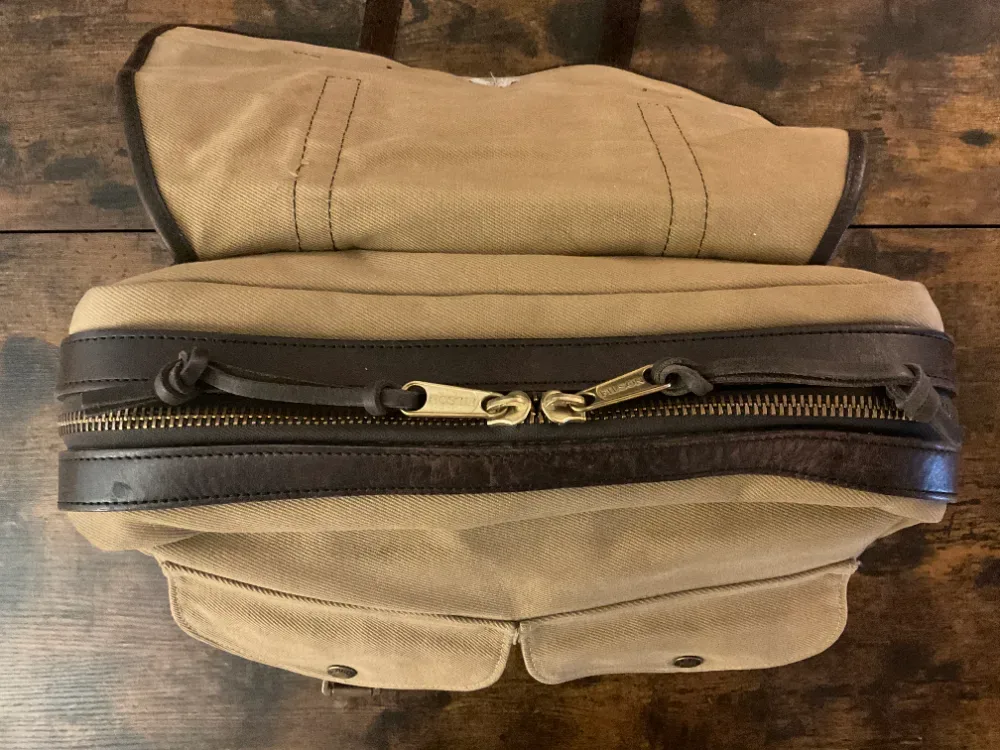
On the other hand if Filson had added a zipper, then you'd be off with the Filson 240 Small Carry-On. The zipper element adds a visible extra height and when closed, the front flap doesn't go much lower because the bag is not as flexible. Also the chunky zipper adds a horizontal rigidity which prevent the bag from flowing along with your body as you move. Suddenly you're carrying a briefcase. And no, that's not what you wanted
V. The Order Within: Inserts and Organisers
Every honest account of the Filson 232 must, sooner or later, arrive at the vastness of its interior. One unbroken compartment is a virtue in the field and a liability at the desk. Keys, cables, adapters, a penknife: everything consorts freely in the dark. Photographers know this better than anyone — drop an unprotected lens into that canvas cavern and it rattles like cargo in a hold.
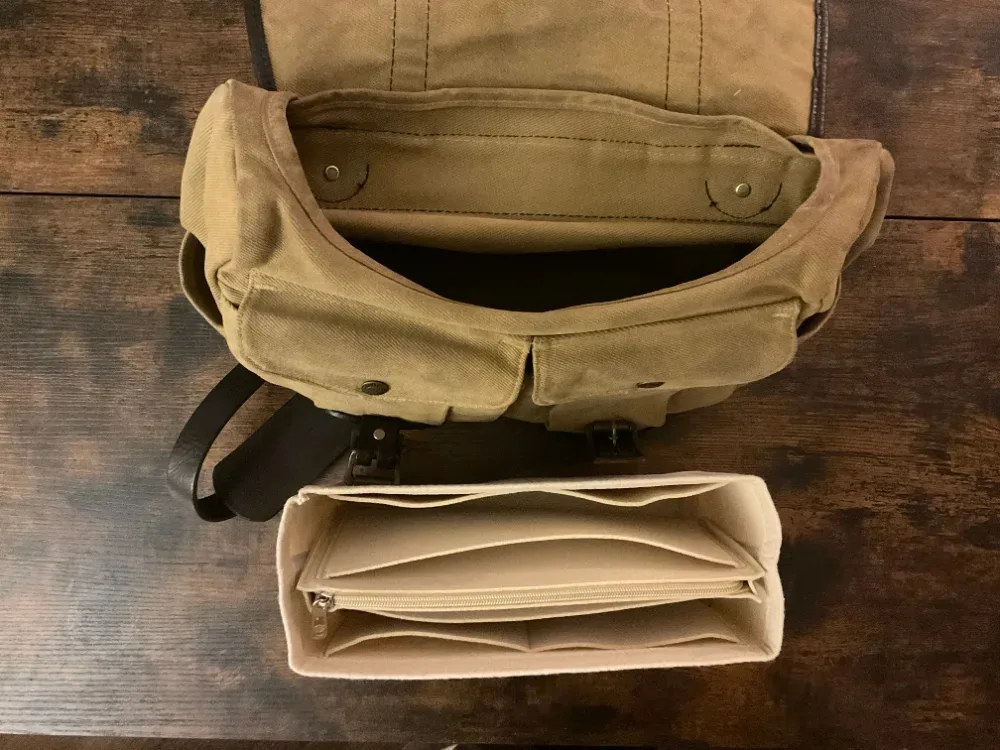
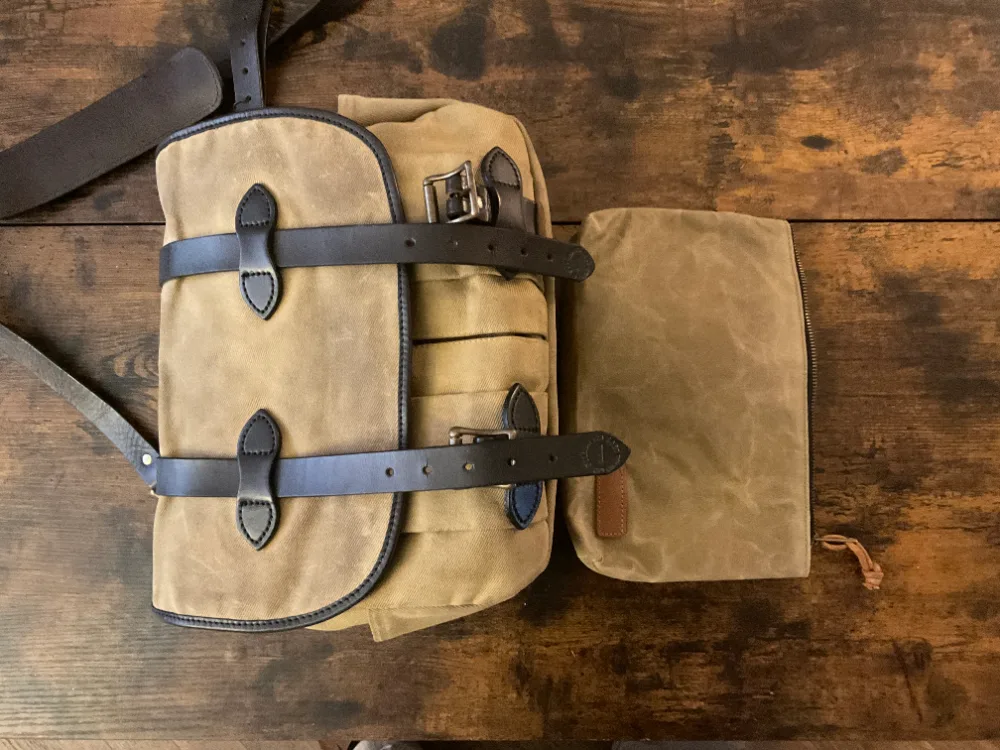
So how do you make the most of that interior? The first is a padded camera insert, which turns the Filson 232 into a capable field camera bag. And from whay I have seen on YouTube, it seems to do an effective job. The second is a simple insert organiser ou a zipped pocket that acts as a divider. And that's how I rock mine. You'll find several organizers on Amazon for less than $20 that offer many pockets and zipped compartments. I personally found a simple waxed canvas zipped pocket which matches the rugged twill and divides the big opening. It's enough for me to have some sort of mental organization. The third is discipline itself: designate the bellows pockets for the small effects (passport, field notebook, sunglasses), the full-length back pocket for flat papers, and resign the hold to the bulky innocents : the jacket, the flask, the folded map.
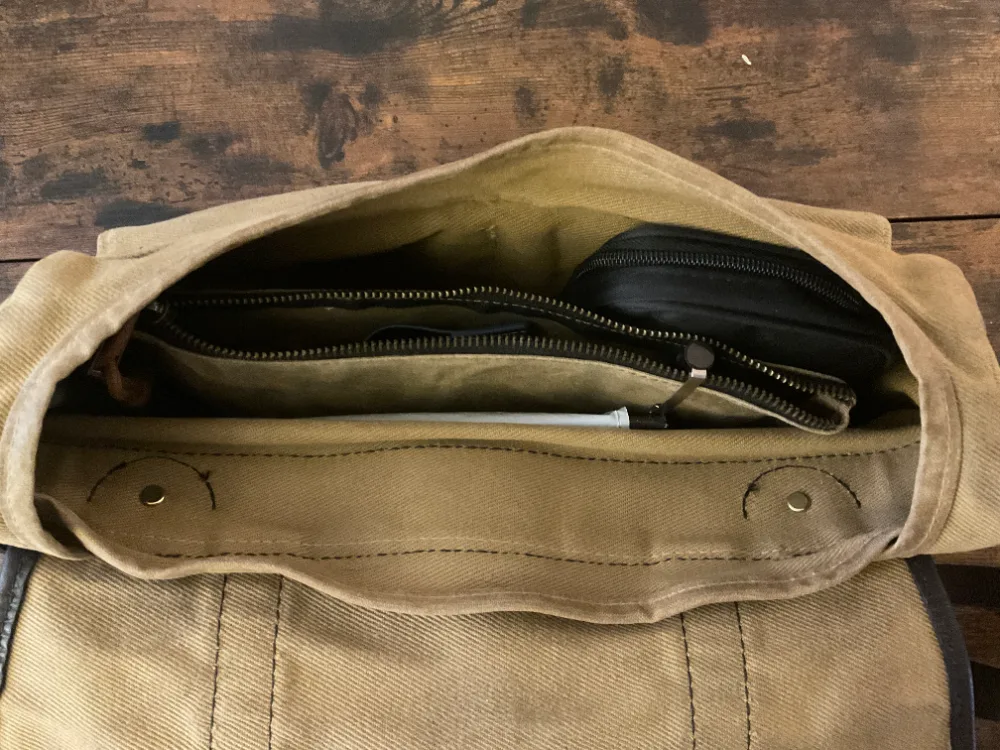
The bag provides the vessel; the traveller must provide the structure. In this, it resembles a good pannier or a ship's locker: indifferent architecture, endless capacity. Methodical packers thrive in it. Those who prefer their compartments assigned by the manufacturer will chafe, and should perhaps read on to the briefcase chapter below.
VI. Not quite a briefcase
Confusion between the Filson 232 and Filson's celebrated briefcases is common. The distinction is fundamental, and rooted in chronology: the Original Briefcase (the Filson 256/257 in the older catalogs) did not appear until 1994, three years after the Field Bags, as Filson's first true office bag. The Rugged Twill canvas may be shared; the intent diverges.
The Briefcase (Filson 256/257): built for the professional. Vertical organisation with interior dividers, sleeves and stow pockets; swift access through a heavy-gauge YKK brass zipper hidden beneath the fold-over flap; rated for a 15-inch laptop. A portable strongbox for documents and electronics, trimmed in the same vegetable-tanned bridle leather that Pennsylvania's Wickett & Craig tannery supplies for horse tack. At roughly 17 in wide, 14 high and 3 deep, it is briefcase-slim where the Filson 232 is field-stout.
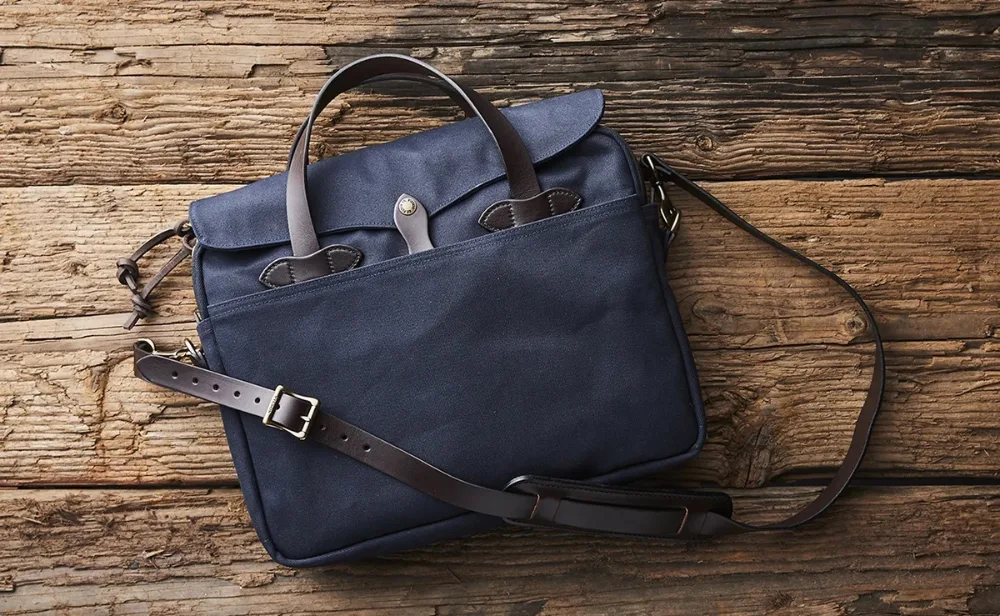
The Field Bag 232: built for the explorer. Top access under a storm flap, one unbroken interior, fast external pockets. A light travel bag that moves from subway to trailhead without changing its character. The Filson 232 is less formal, more feral. It does not ride comfortably tucked under the arm alone; it is made for cross-body carry, its low attachment points steadying the load as you walk. Veteran owners put it plainly: documents and electronics belong in the briefcase, kept vertical and sorted; everything that must simply come along belongs in the field bag.
VII. Expanding the Ledger: The 232 and the 240
Let us settle the ledger between the two close cousins.
The Filson 240 Small Carry-On is a closed fortress: YKK zipper beneath the storm flap, a taller silhouette, a stiffer carriage. It suits the traveller who fears rain and light fingers above all else — documents sealed, electronics cased, contents locked behind two doors. Its costs are the flip side of its virtues: the zipper adds height and a horizontal spine of rigidity, so the bag sits more like luggage and less like a garment. Carried, it reads as a valise.
The Filson 232 Medium Field Bag trades the vault door for the open trail. No zipper across the top; two quick side pockets the Filson 240 cannot afford; a body that folds against your hip as you move. Its risks are precisely its virtues: the unbuckled flap admits a hand quickly. Yours, or, in a dense crowd, conceivably another's. Rain and sand negotiate with the flap rather than being refused outright.
The choice is a philosophy before it is a purchase. He who secures everything carries a small safe on his shoulder. He who trusts the road carries a saddlebag. Twenty-five years of catalogues suggest most travellers, given the honest comparison, choose the road.
VIII. Rain, Sand and Honest Weather
The Lodge's rule is candour, so here it is plainly: the Filson 232 is water resistant, not waterproof. The Rugged Twill sheds a shower the way oilskins shed spray. The first quarter-hour of drizzle slides off the storm flap, and the contents emerge dry. But the fabric is not wax-saturated like Tin Cloth, and there is no zipper standing guard across the throat of the bag. Under a sustained downpour, water will find its way past the flap, first as a darkening of the canvas, then as a damp edge on whatever rests at the top.
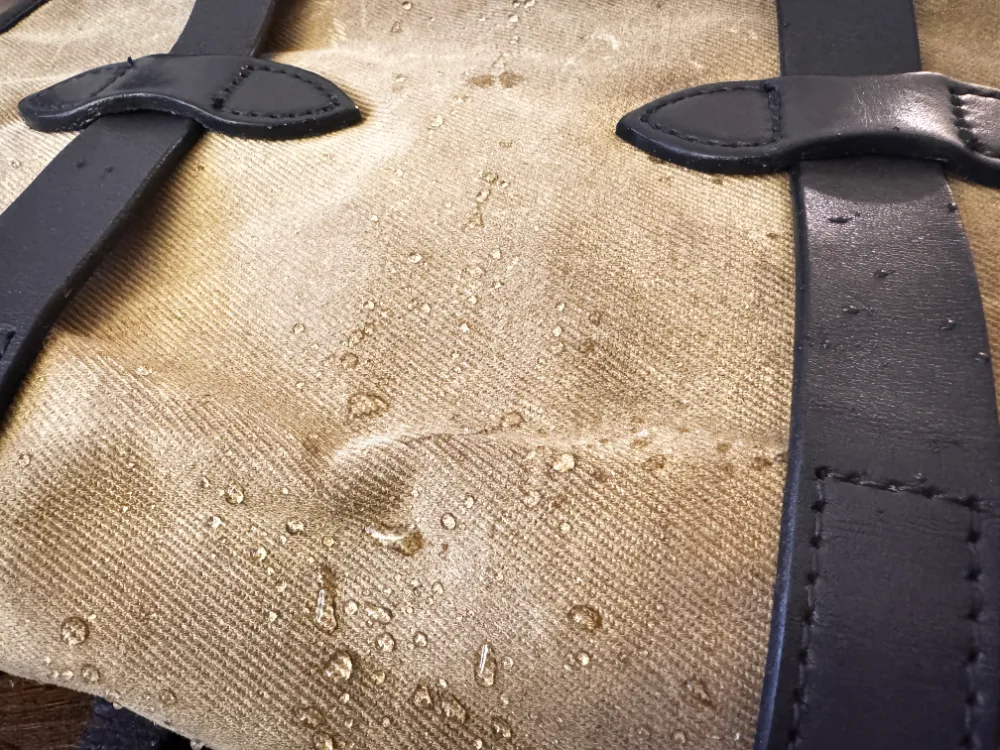
For city commutes, sudden showers and river-mist, the bag is equal to the weather; a brisk shake and a dry evening by the stove see it restored. For open-water crossings, all-day monsoons or dusty expanses where sand seeks every seam, the disciplined traveller adds a liner ; a dry sack, a folded bin bag, or one of the waxed rain covers sold for bicycle couriers. None of this diminishes the design; a storm flap is a gate, not a wall, and it was drawn in 1991 for prospectors of the everyday, not for divers.
Keep it honest, keep it brushed, and never store it damp in a closed car or cupboard. The twill forgives weather; it does not forgive neglect.
Behind every stitch stands Filson's lifetime guarantee, which repairs or replaces anything that fails in normal use. Small wonder so many 1990s originals are still in daily rotation, carried by their second or third generation of owners like a well-thumbed surveyor's compass passed down the line. That guarantee, however, only applies to goods bought from the Filson.com website. If you are in the EU, for instance, Filson.eu only applies a two year guarantee. You can buy your bag from Filson.com but you will have to pay for tax and shipping. And you will have to pay for them again if you return you bag for repair in the USA.
IX. Final thoughts
The Filson 232 is not the most convenient bag for an intense desk-bound routine. Its side pockets run a bit too narrow for a standard bottle, its main access is somewhat laborious, and its indifference to internal order will tax anyone who likes their compartments assigned for them. It is a demanding choice, and honesty obliges us to say so.
Demanding it may be; the reward is proportionate. In an industry addicted to seasonal redesigns, the Filson 232 has carried the same silhouette since 1991 and is still in the catalog, a tenure most bags can only dream of. It has outlived the fashion cycles that laughed at canvas, and it will outlive the ones currently laughing at it. At the time of this writing though, it is only listed in Filson.eu and nowhere to be seen on Filson.com.
Production realities have admittedly shifted under its feet, and the honest chronicler must record them. The 2012 run was sewn in Seattle from American bridle leather and listed at $225, the price of a good coat. Today's edition is assembled in Italy, trimmed in supple Italian cowhide, and listed near €500, the price of a good coat having learned some Latin. The debate among the faithful runs predictably. The old bridle leather was harder, paler, slower to break in and near-eternal in service. The Italian cowhide is softer to the touch, darkens beautifully, and, say the skeptics, may know less of privation. On the second-hand market, the bridle-leather Seattle specimens command genuine hunting-party interest, their bids rising the way good cartographic rarities do. Our counsel, after handling both: the stitches remain tight, the canvas remains the same British Millerain twill, and the guarantee remains the guarantee. The bag is still unfailing. It simply speaks its vowels differently now.
For anyone seeking a companion able to cross seasons, absorb the knocks of rail travel and develop a patina of its own, it remains a sound investment. It embodies the idea that gear should not merely serve but accompany. Like an old field notebook whose pages fill with sketches and recollections, the Filson 232 wears in order to become yours, a classic that does not age so much as mature.
As for me I believe I have found the bag that completes my Filson Journeyman backpack. It is flexible enough to serve as my everyday satchel, big enough for a laptop yet not so big that it reads as a briefcase. And the double-walled bottom is the detail that seals the pact, a quietly overbuilt foundation that gives me every confidence this bag and I will keep the trail for several decades yet.
X. A little hack for the Filson 232
So fiddling with buckles might not always be easy not very fast when you are used to a faster closing mechanism. Many people simply do not close those buckles and leave the top flap as it is. Now if your bag is not over loaded you can try this hack which I use. It enables the top flap to go much lower and way below the buckle point. Suddenly the Filson 232 get smaller and easier to manage.
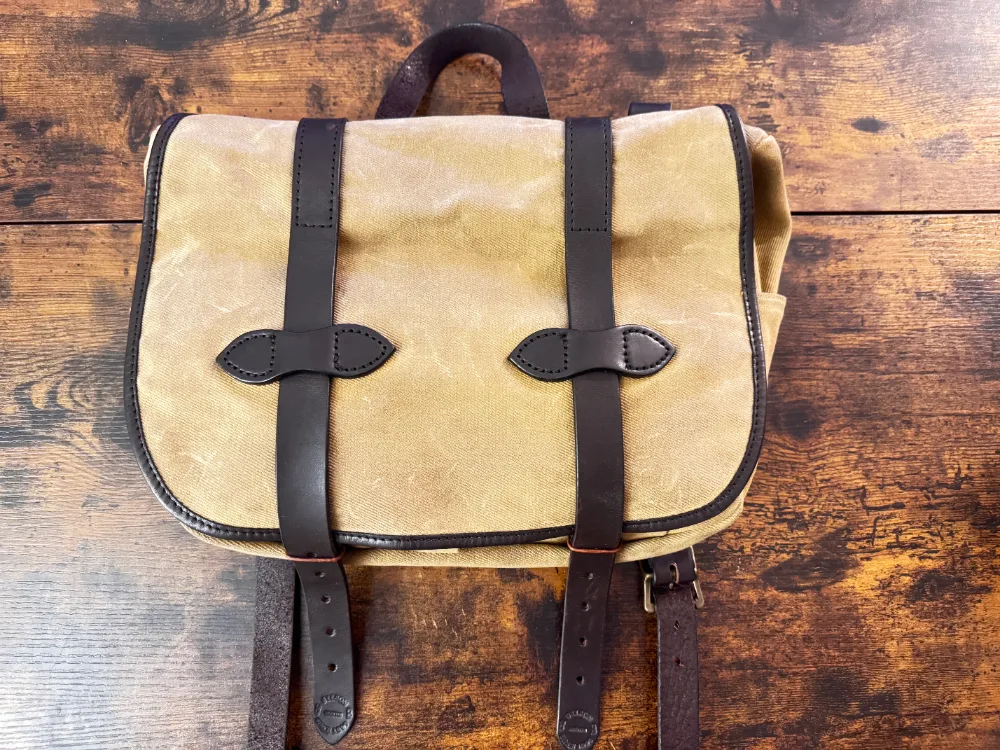
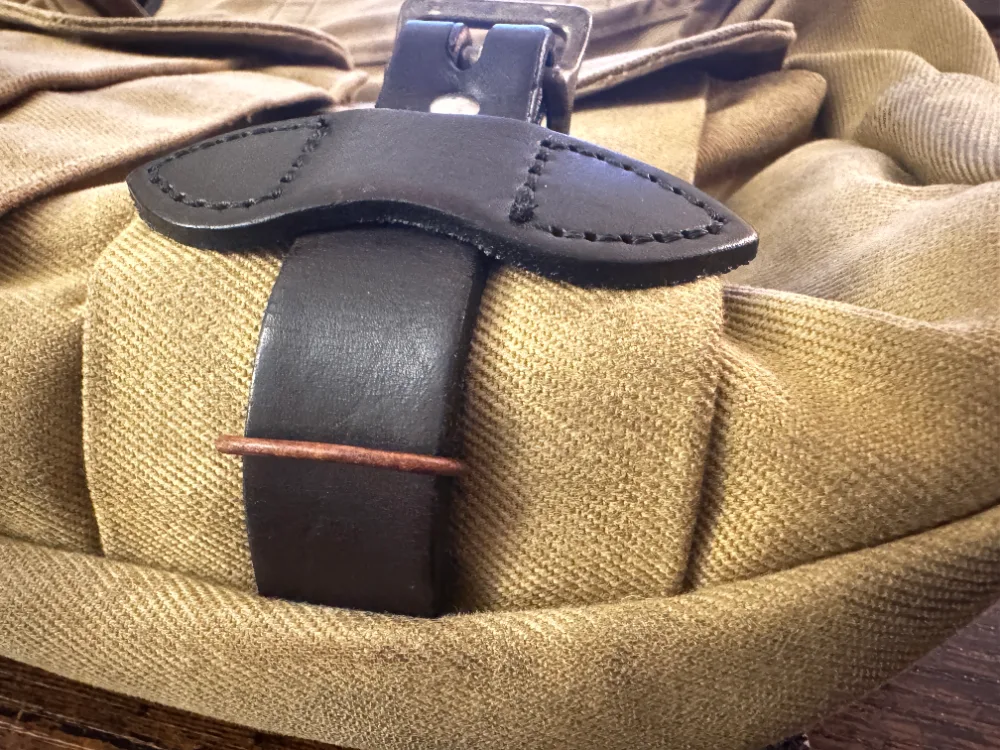
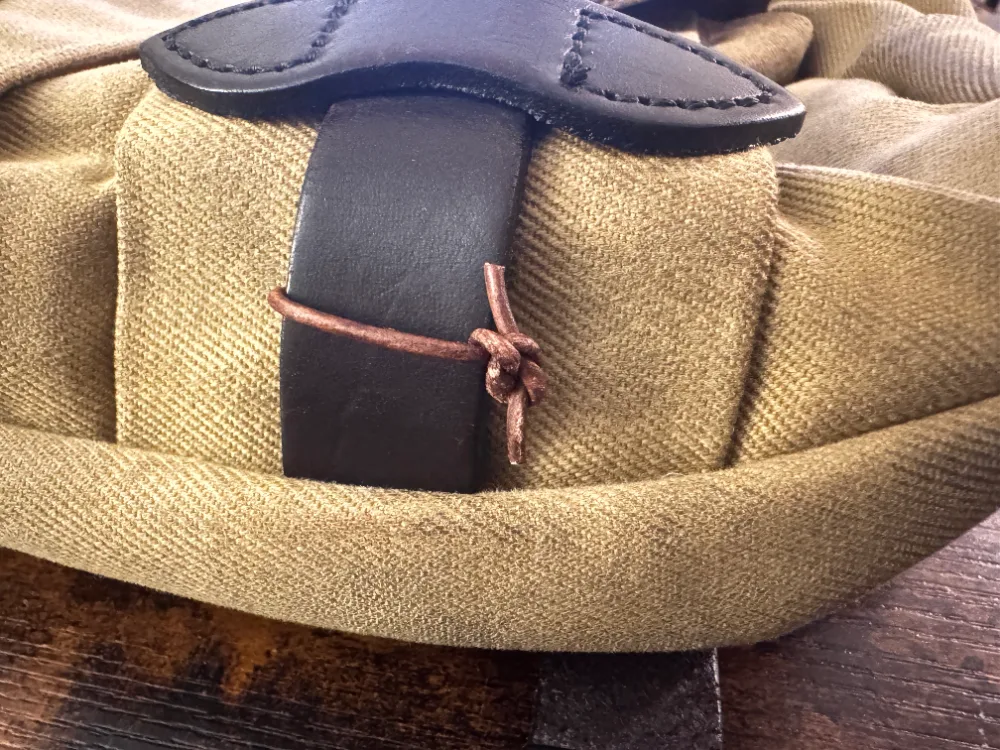
Simply attach a leather thread or a hair elastic on each bottom side of the buckles. It's perfect for light carry. And switch to the buckles when the bag is more loaded. The bag suddenly has two different configurations, and two different designs. This is precisely what you can't do with the extra height that the Filson 240's zipper adds.
XI. Leave a comment
No comments yet.