
Field note N° 04 ·
A review of the Nutsac Satchel 13
On paper, the dimensions are perfect, but can this really be and EDC bag?
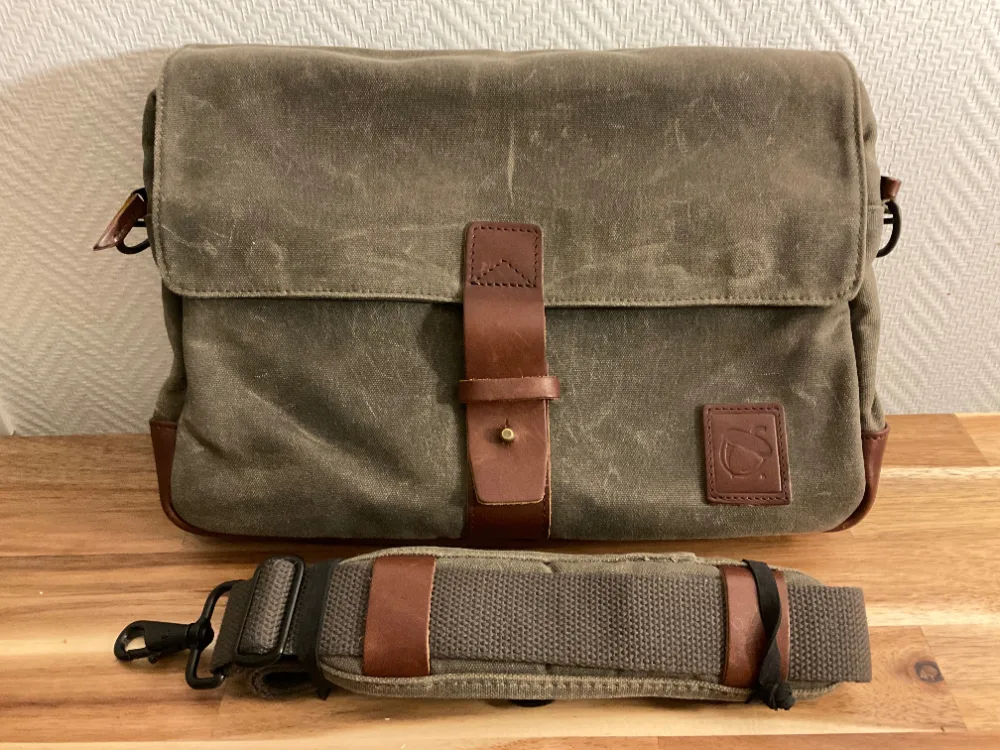
The NutSac Satchel 13 arrives less like a commuter bag and more like dispatch gear from a bygone era of exploration. It's a compact messenger forged for the road-worn traveler who carries a 13-inch laptop or professional tablet alongside field essentials. Its silhouette tries hard to speak the language of vintage field satchels and colonial-era dispatch cases with a rectangular profile, a commanding flap closure, brass-toned hardware, and a solitary top handle. This is an object that reads better beside a weathered map spread on a desk than tucked beneath an office cubicle light. But what is it like to actually use it?
Note on the naming
A matter of naming requires clarification before setting out. The numeral 13 does not refer to liter capacity but to the diagonal measurement of the device this pack accommodates. True volume sits at 6.7 liters. That's the one you get if you have a MacBook Air/Pro 13''. This model succeeds directly the "Satchel Pro," inheriting its architecture under new designation. And that's probably to better speak to those who carry a laptop.
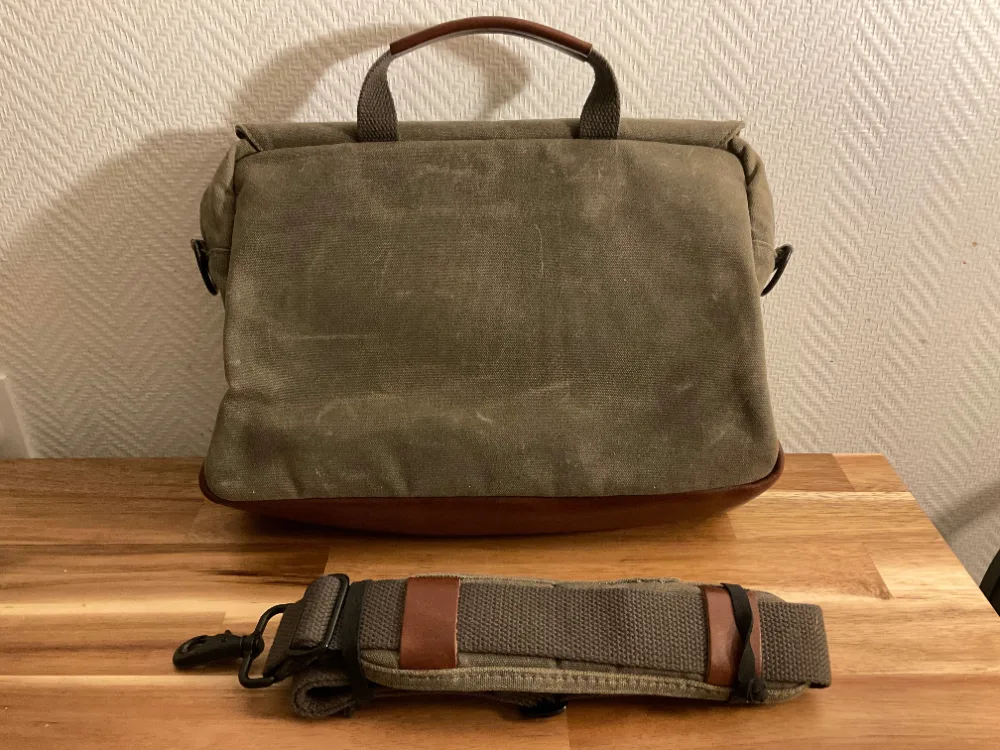
I. What does my Nutsac look like?— Haven't you heard this one way too often?
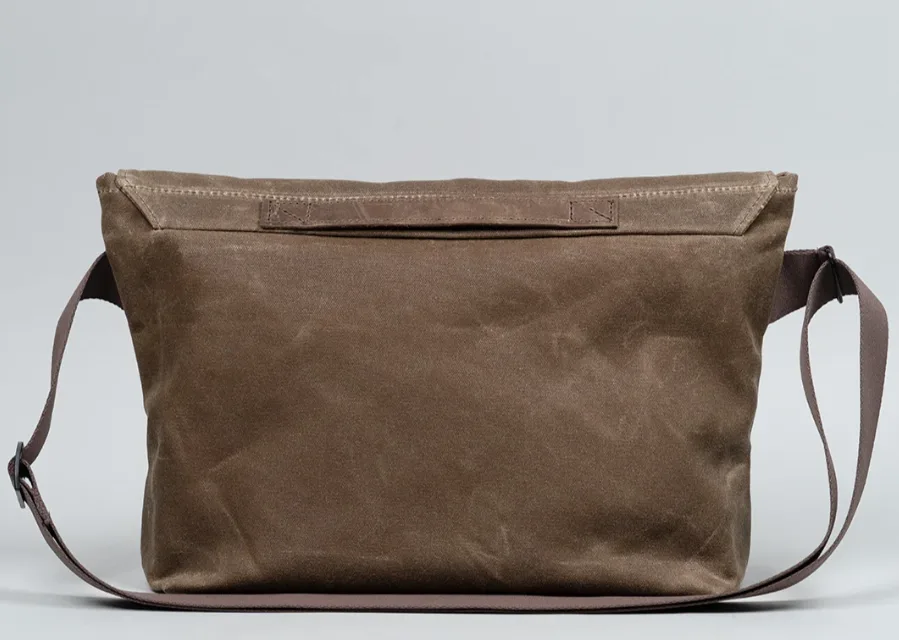
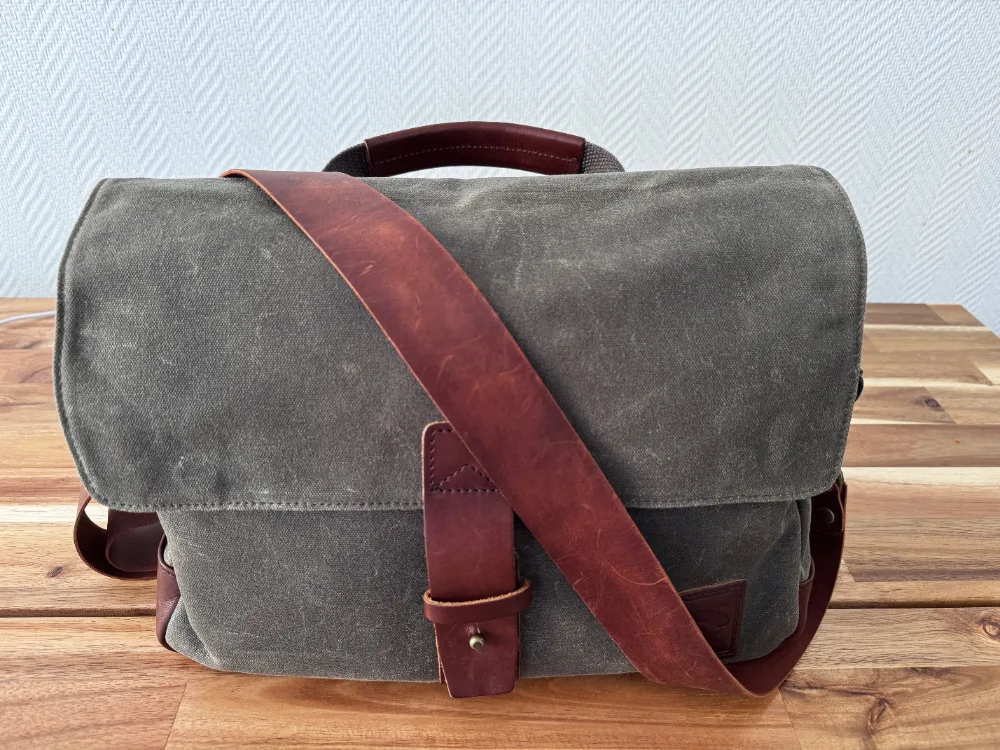
Before getting this Nutsac, I was looking for an EDC satchel which I could carry with me everyday and in which I could occasionally slide in my laptop. This one is approximately 33 cm width (13 in), 23 cm height (9.1 in) , and 9 cm depth (3.5 in). In theory, it is perfect. And I know I'm not alone. This is precisely why they made it. Weight registers at 880 grams (1.94 lb) with strap deployed and 720 grams (1.6 lb) stripped to bare pack—contained mass for canvas-and-leather construction.
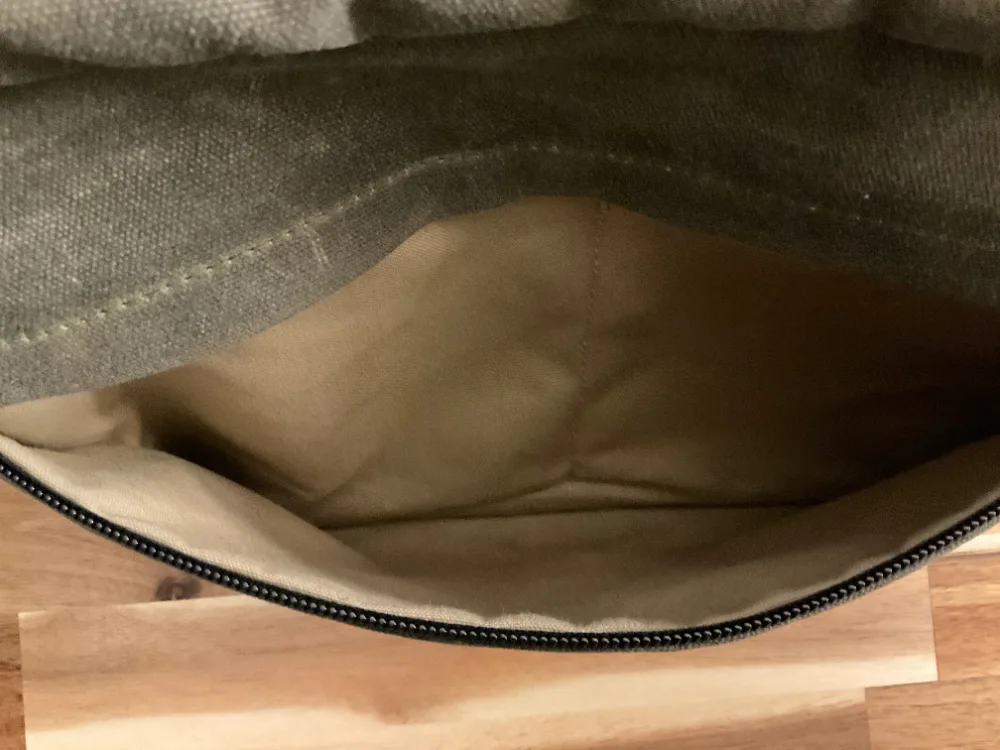
Internal stowage comprises three stations only. Two zippered pouches roughly 15 cm (about 6 in) wide command the front face, sized for pouch, pens,phone, wallet, external storage drive. A flat zippered station spanning full width occupies the rear, designated for magazine, passports, or valuables requiring secure storage. Nope, that laptop, won't fit in it. Beyond these lies a single compartment without dividers or predetermined organization. No padded laptop sanctuary exists: 13-inch compatibility holds true, yet device protection rests solely upon minimal cushioning at the base. And a protective sleeve around your laptop better be thin. Otherwise, it just won't fit in.
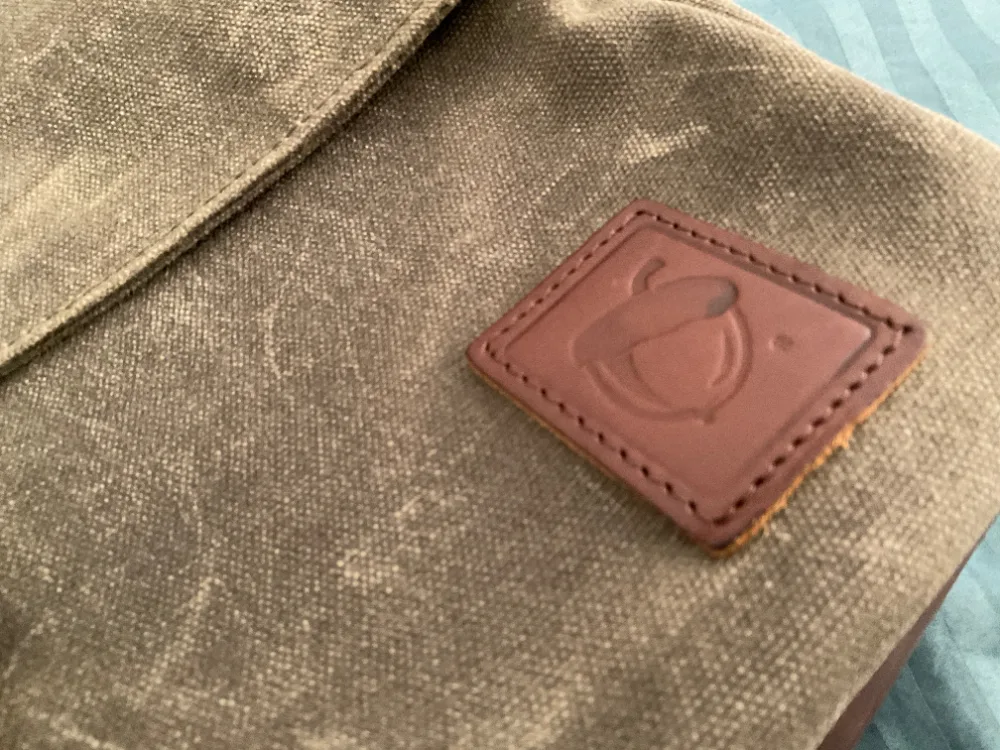
Perhaps it's because I'm European, but I despise that leather front tag stitched onto the face of the bag. Quite objectively, it serves no purpose whatsoever. I have no particular desire to advertise for a company I've just purchased a bag from. Positioned at the bottom right, this leather label could at least have been centered on the closure strap. It would have looked less out of place. Or, more subtle still, they could have placed it on the side, just to add a small touch of detail. But no, the company had to stamp its logo onto the exterior, on top of its branding already present inside the bag. This is pure marketing , with no consideration whatsoever for the consumer.
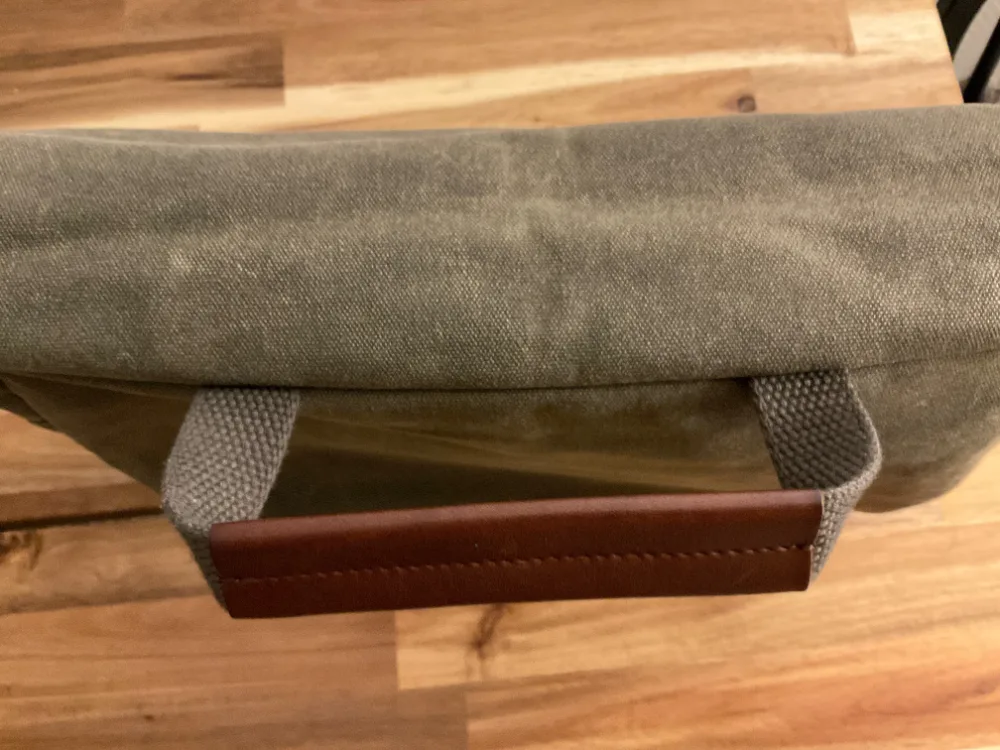
Some consider the handle poorly placed. Since it is not centered, the bottom of the satchel tends to tilt toward your leg. And indeed, over time, this can become uncomfortable to carry. But had they positioned this handle in the middle, it would have rested on the front flap. And that could have created tension on the flap itself. The integrated magnets wouldn't have been strong enough. And, the closure strap attached to the stud button might eventually tear more easily under such strain. Personally, I don't hand carry bags a lot, so I do not really mind. However, I would have preferred a flatter, more discreet handle, somewhat like the one on Waterfield's Vitesse Cycling Musette.
II. What is the Nutsac Satchel 13 made of?
Martexin Waxed Canvas — The Outer Shell
Here the pack reveals its soul. The outer shell emerges from cotton canvas saturated with wax, identified as Martexin Waxed Canvas on manufacturer documentation. This material traces lineage through centuries of military and civilian service ; canvas density infiltrated with waxy substance rendering it resistant to water, grime, abrasion, and tearing. To hand, it presents as notably rugged without stiffness or excessive greasiness. Structural integrity permits the bag to maintain form even when sparsely loaded.
Time leaves its signature upon this surface. The wax develops a patina, recording creases and friction marks, giving the bag a lived-in, weathered look. Not everyone like this. Some read it as earned character, others as premature aging. One must ultimately distinguish water resistance from true waterproofing: waxed canvas withstands light rain and splashes without complaint, yet remains permeable under sustained downpour. Periodic maintenance (wax reapplication) becomes necessary to preserve its water-repellent defenses, much like treating leather boots before setting out on a long trail.
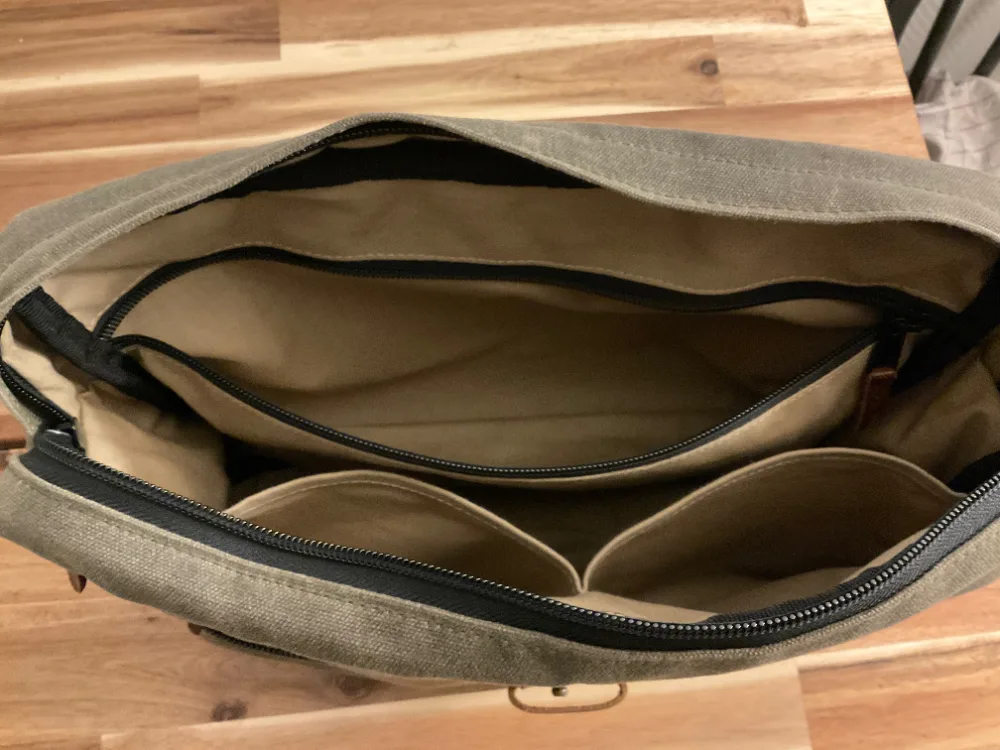
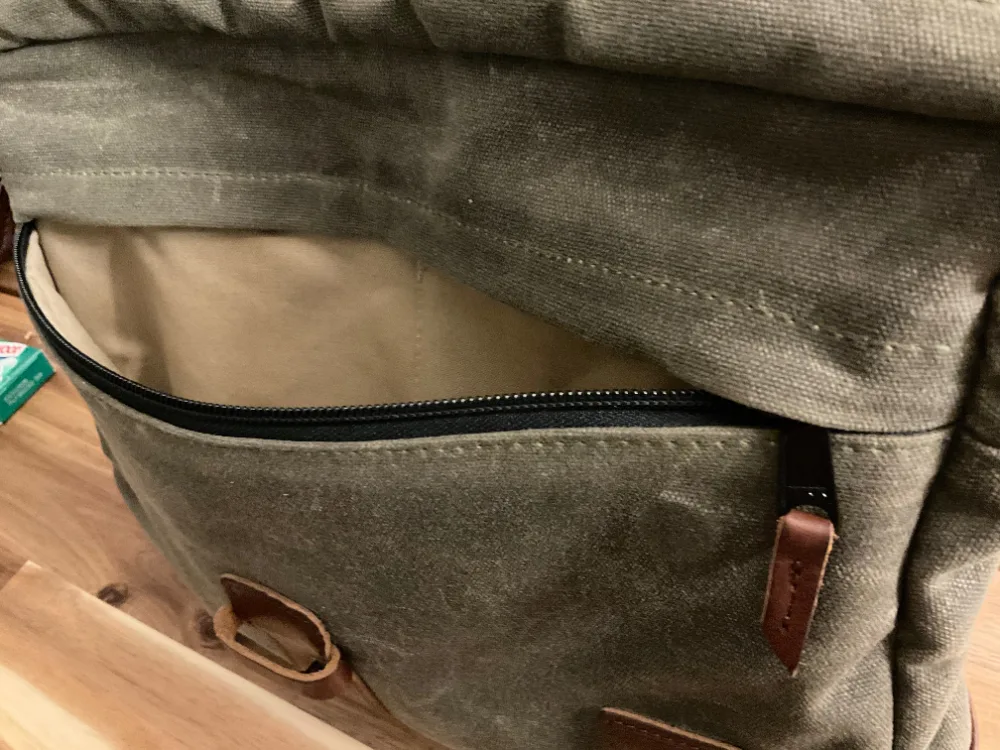
If you were wondering, yes, this is the tan version listed on their website. And yes, the real color is olive/dark khaki
Full-Grain Leather — Reinforcement and Refinement
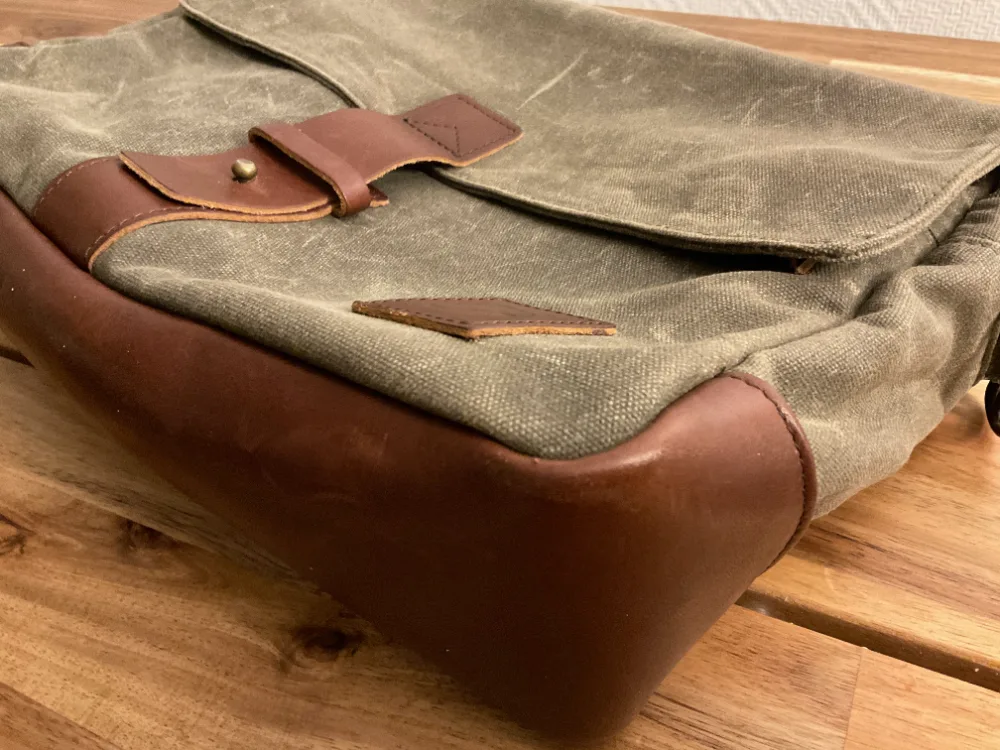
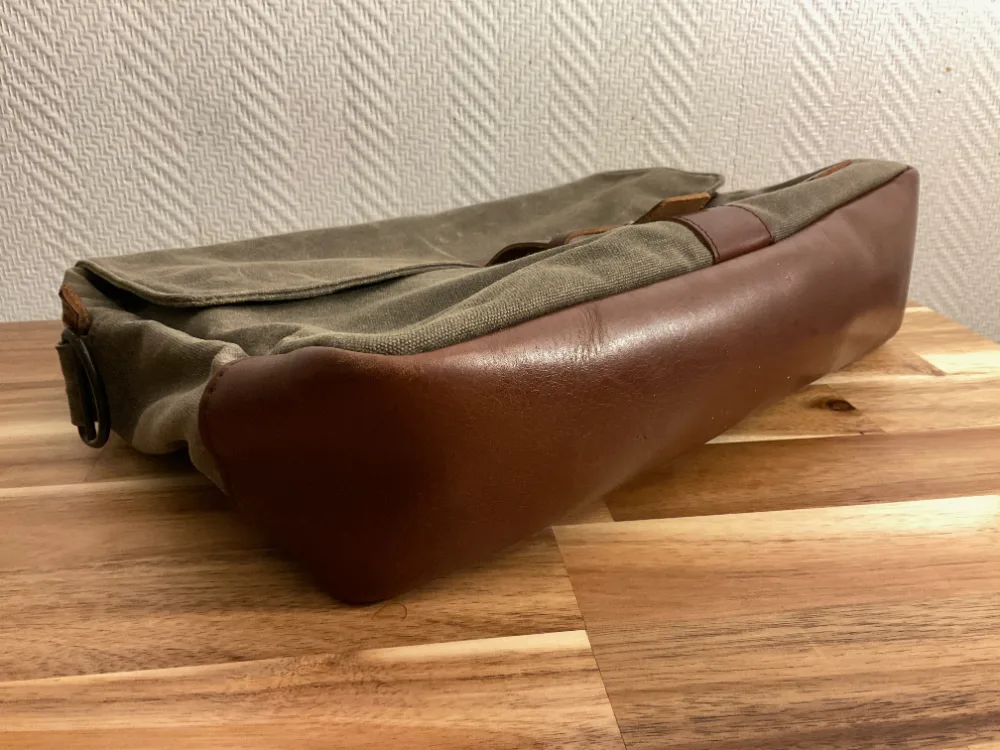
Leather serves as the second structural element. This is full-grain hide, described as premium pull-up on commercial documentation and top-grain within certain field assessments. It reinforces strategic zones rather than blanketing the entire assembly: closure strap and buckle mechanism, top carrying handle, logo-bearing panel, zipper pulls, and a bottom band wrapping beneath the pack to shield against ground abrasion. But we'll come back to it. This leather reads as sturdy yet supple (though, not enough in some cases). It has finish contrasting the canvas's rustic character and contributing to perceived quality. And like the canvas, it will develop a patina.
Hardware and Construction Details
All metalwork runs solid throughout. Zippers originate from YKK, an industry standard for slider and tooth reliability under field conditions. The main flap secures via traditional stud buckle augmented with magnets enabling rapid engagement without complete strap manipulation. Stud buckle closure mechanism certainly is the best in my opinion. And one centered strap makes it even easier and faster. At opposing pack ends, we found black D-rings for the shoulder strap. Interior construction reflects parallel concern for durability: seams receive reinforcement, assembly joints tape-sealed to retard fraying and restrict moisture infiltration. Stitching remains consistent throughout.
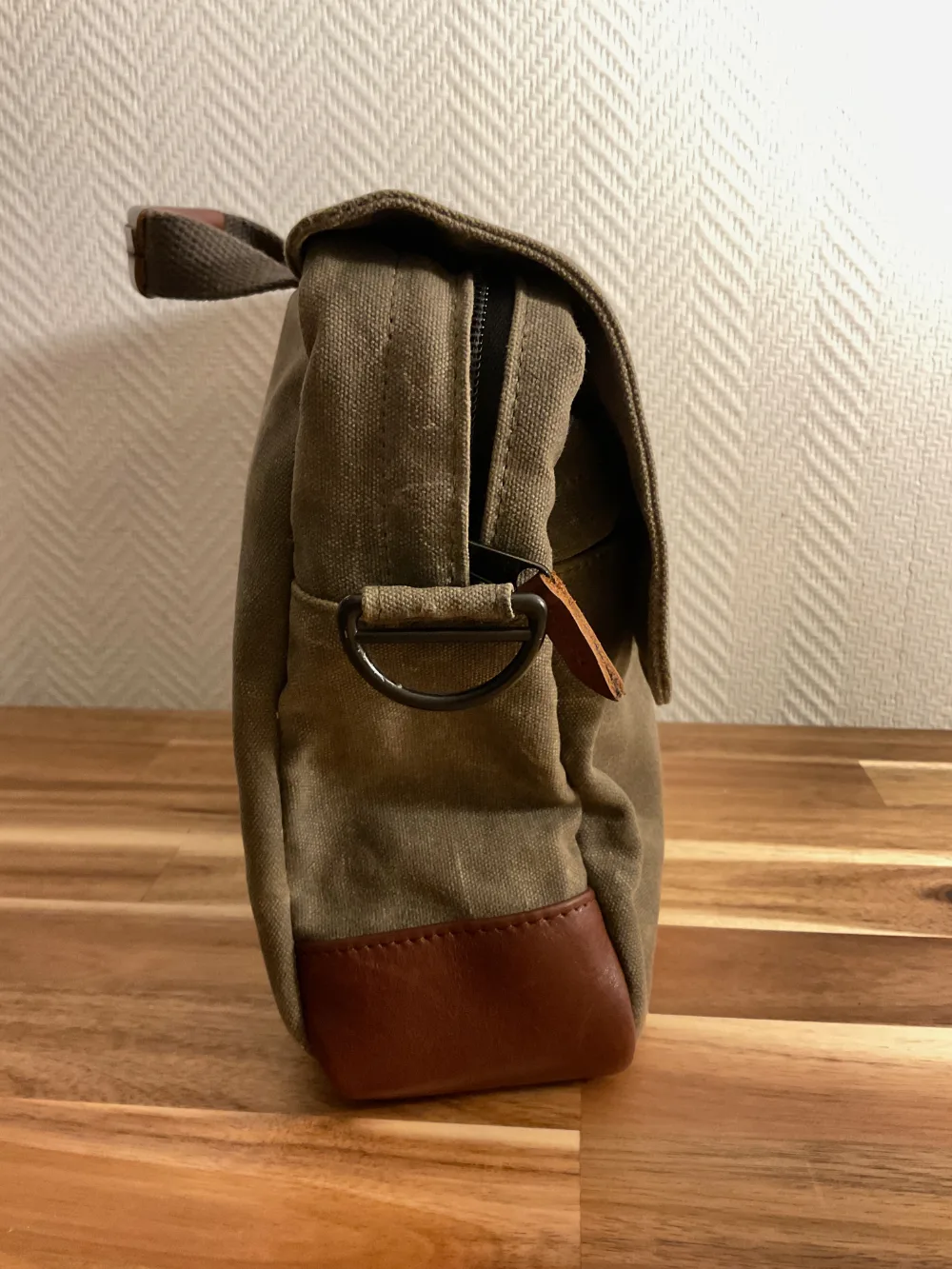
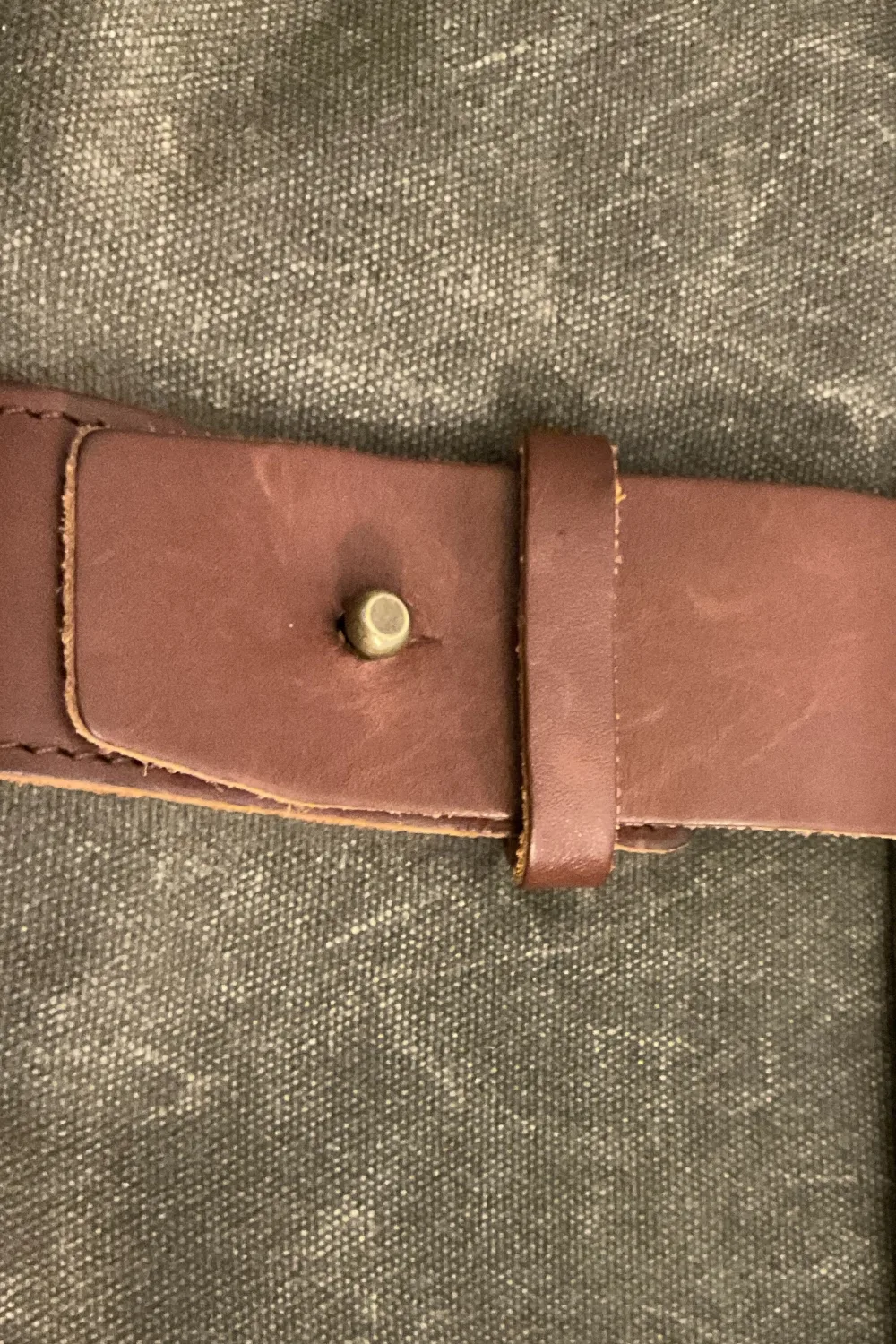
Shoulder carriage operates through a removable strap woven from thick cotton webbing, approximately 38 mm (1.5 in) width, adjustable from roughly 90 cm to 170 cm (3 ft to 5.5 ft) in length. Ventilated mesh padding distributes pressure across the shoulder during extended marches. But that mesh padding just seems out of place to me. In fact the whole strap was not really to my taste. I switch it immediately for one that is made out of leather (see below). If you are interested, I got it from Innesbag, on Etsy. It's 4 cm wide (1.6 in), and the exact same thickness as the closing strap. Metal connectors secure the strap to the anchor rings. Carriage options remain flexible: shoulder, cross-body, or hand-carry alone depending on mission requirements and comfort preference.
The Tacsack version of the Satchel 13 has the shoulder strap attachment points on the back panel instead of on each side. I have not tried this model, but I believe it should feel a bit better when carried as a cross body messenger bag.
III. That Nutsac is not big enough
In theory, the dimensions were just perfect. But in practice, that's another story. I came to realize that 6.7 liters is genuinely very little in terms of capacity. You will no doubt read this almost everywhere, but it holds true: once your laptop is slipped inside, not much room remains. Then begins the game of Tetris, ending with what is essentially a large brick. And such a brick resembles a briefcase far more than a messenger bag.
Beyond build quality, it therefore remains essential to know exactly what you plan to carry daily. In addition to your keys and a pouch holding your small EDC essentials, perhaps you would like to add a windbreaker from time to time, a book, a cap and... ah, no, too late. No more space.
The front zippered pocket offers no gusset whatsoever. It lies flat against the body of the bag and, in terms of width, will hold no more than a single book. If you can picture the structure of the Goruck GR1 Heritage, then you already have a good idea of what to expect.
IV. That Nutsac is overbuilt
The construction method employed for this satchel imparts a certain rigidity and rugged robustness to its frame. However, make no mistake, this is emphatically not the type of EDC satchel I personally seek on the trail. In practical terms, you're left with what amounts to a briefcase swinging laterally from right to left at the side of your leg or hip, refusing to contour or conform to your body's natural shape. The primary culprit: the leather base plate, which refuses to yield under load.
Admittedly, one can wear the pack as a cross-body configuration, routing it completely behind and settling it between the lower back and seat. Yet accessing contents becomes considerably more cumbersome the moment you need to retrieve something mid-journey.
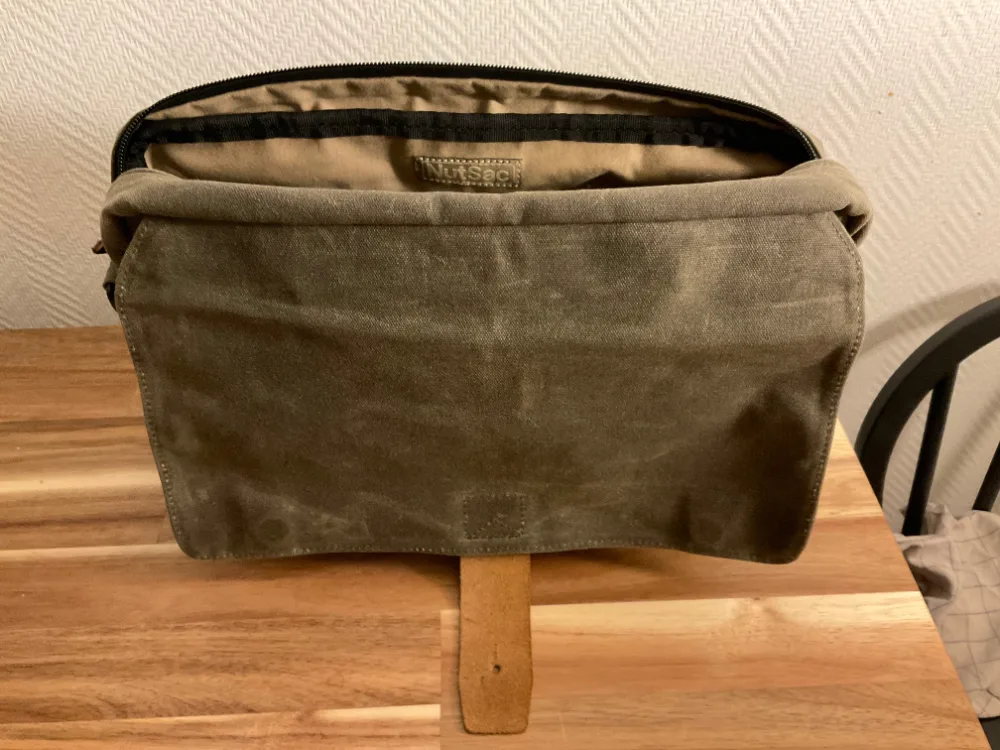
Fabricating an overbuilt bag presents no particular challenge. Crafting one that proves genuinely agreeable for daily use is where the real difficulty lies. This mirrors precisely the obstacle I previously encountered with the Goruck GR1 21L Heritage. When I hear some voices claiming that backpack represents perfection for everyday carry, the truth stands in opposition: overbuilt to excess, lacking meaningful flexibility, zippered closures with proof-coated teeth that resist smooth engagement, shoulder straps aggressively wide and thick beyond necessity. In short, everything to be avoided when seeking a physically adaptable pack for quick insertion and removal of gear during daily operations.
In essence, the NutSac Satchel 13 reads as the briefcase counterpart to the Goruck philosophy. Were I told that NutSac operates as a Goruck subsidiary, it would not surprise me. Both companies pursue a similar direction: applying a contemporary aesthetic to nearly identical material choices, that is, waxed canvas, full-grain leather, heavy hardware. And without reconciling those selections with the mobility required for genuine everyday field use.
V. The patina after few years of daily use
After realizing that the Nutsac Satchel 13 was not for me, I sold it after six weeks of use. So I can't speak for its longevity. But the good news is, other have done it. For instance, YouTuber Timothy Brown is showing what the Nutsac Satchel 13 looks like after 4 years of daily use.

And even after 5+ years. It seriously start showing tears and abuse here and there. It looks beat up and has a serious rugged feeling.

VI. Final Thoughts
I had truly high hopes for this bag. On paper, everything seemed perfect. But in actual use, I felt more like I was carrying a metal briefcase than a canvas satchel. If the bag had featured a waxed canvas base and 2–3 cm more depth, that would certainly have changed the equation.
But that's also on me. I can't help thinking that a leather base offers far better resistance to the elements. I simply hadn't fully accounted for the rigidity that comes with it. As with the Goruck GR1 21L Heritage, I'm beginning to understand that finding the right balance between construction philosophy and real-world daily use is essential.
There are bags on the market of comparable quality, perhaps even with superior canvas, paired with a structure more deliberately designed for my personal everyday needs. That's what I'll be seeking moving forward.
VII. Leave a comment
No comments yet.