
Field note N° 03 ·
A review of the Redwood Kilroy field watch
One watch. Forever. Challenge?
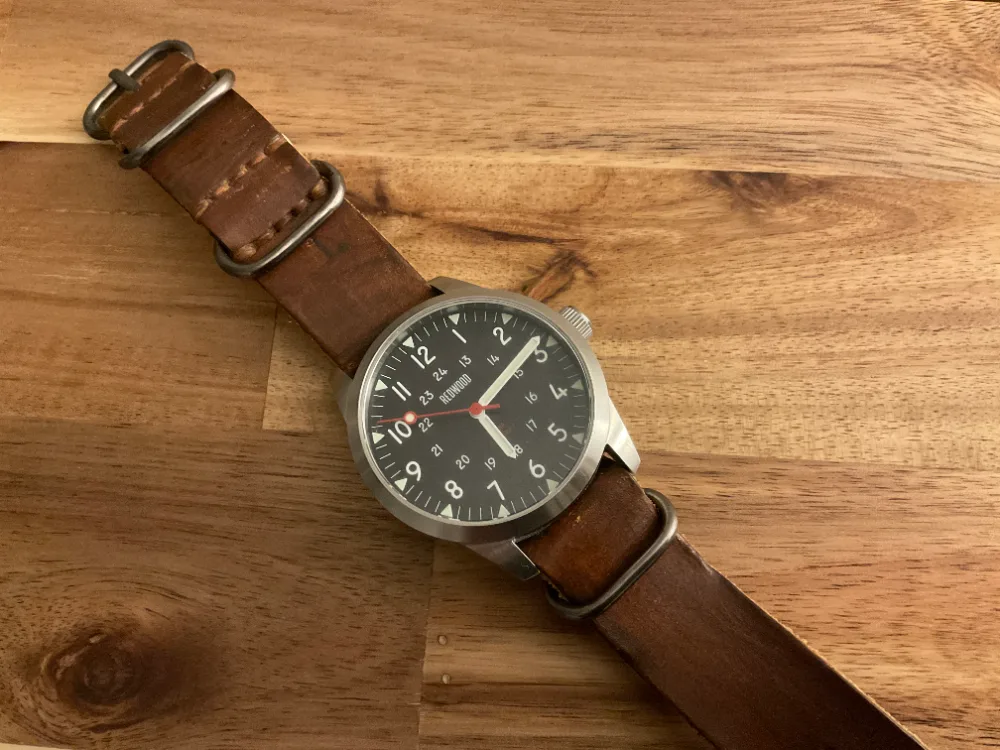
One watch. Just one. For some, that's impossible. For me… well, I never really had the means to build a collection. So I might as well pick the one that will stay. For a long time. A very long time. And no, I didn't throw money around to treat myself to it. And yet, yes — it's probably the best value for money out there.
I needed a watch to replace my Timex Expedition, which I carelessly broke on a trip to Belgium. I loved that watch. Simple, extremely legible, with crisp contrast. No pointless complications I'd never use. Nothing showy. A sober watch on a leather strap. Not too heavy, and properly water-resistant. It had that rugged, field-worn look I'm so fond of.
I did own a Hamilton Khaki Field first, but I'll come back to those misadventures in detail in another article.
The only thing that ever bothered me about the Timex was the lack of any artisanal character — or rather, the thought of my money feeding a corporate giant. But surely somewhere out there, small watchmaking houses crafting honest, quality timepieces without demanding a king's ransom?
So I set out to explore the furthest corners of the web.
I. What is the Redwood Kilroy anyway ?— My dream come true
OK let's dive right into the beast
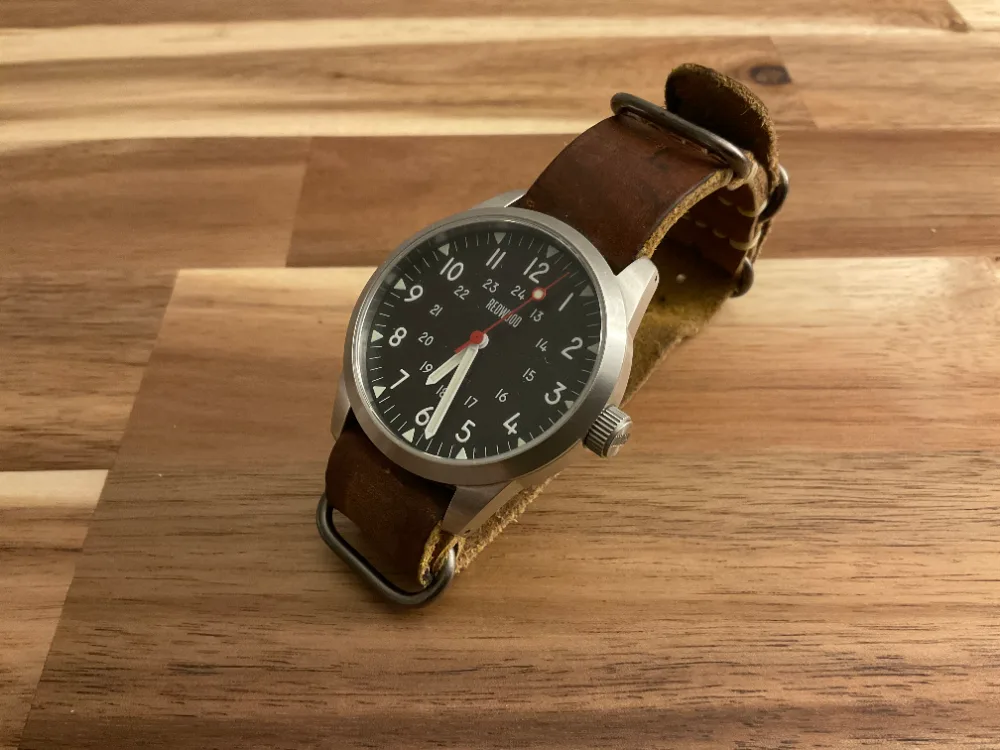
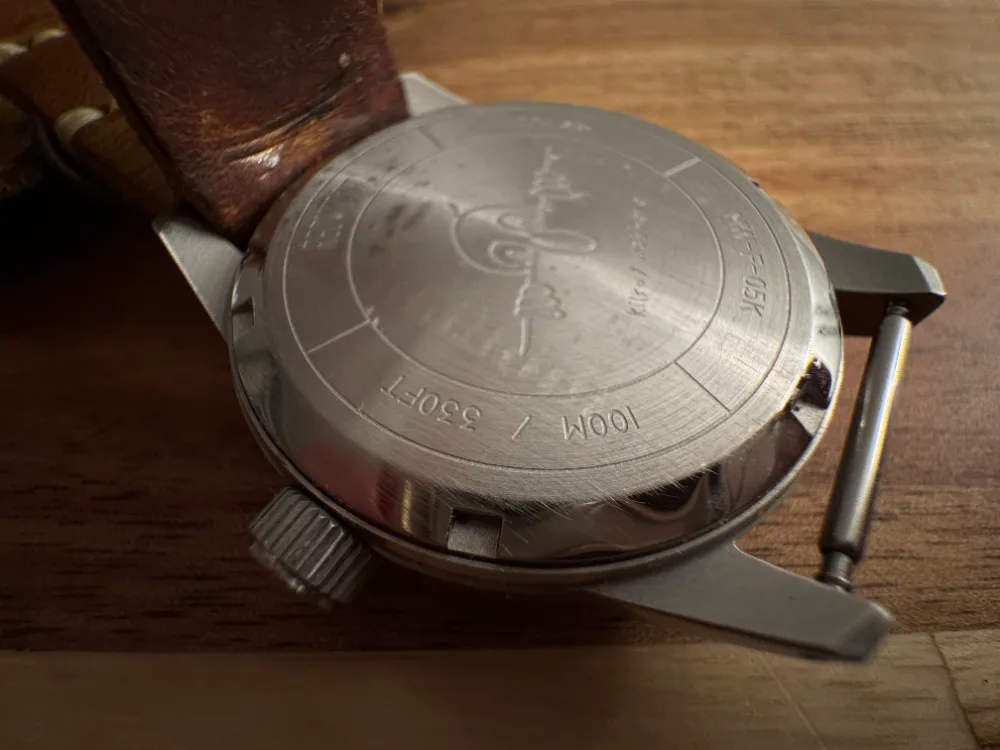
At the heart of the Kilroy's bulletproof construction lies a 40mm brushed stainless steel case — a deliberate modern sizing, when the vintage mil-spec originals it draws from measured a mere 31 to 35mm. At 46.5mm lug to lug and a slender 10.7mm thick, it sits comfortably on the wrist without ever announcing itself. The massive lugs, drilled for easy strap changes, are insurance against failure on the trail, while the oversized 6.5mm coin-edge crown screws down firmly — a nod to the days when a watch had to survive mud, rain, and worse. Crown and caseback are both threaded and sealed, earning the Kilroy its 10 ATM (100m / 330ft) water-resistance rating: mission-ready, in the true spirit of the MIL-W-46374 field watches that inspired it.
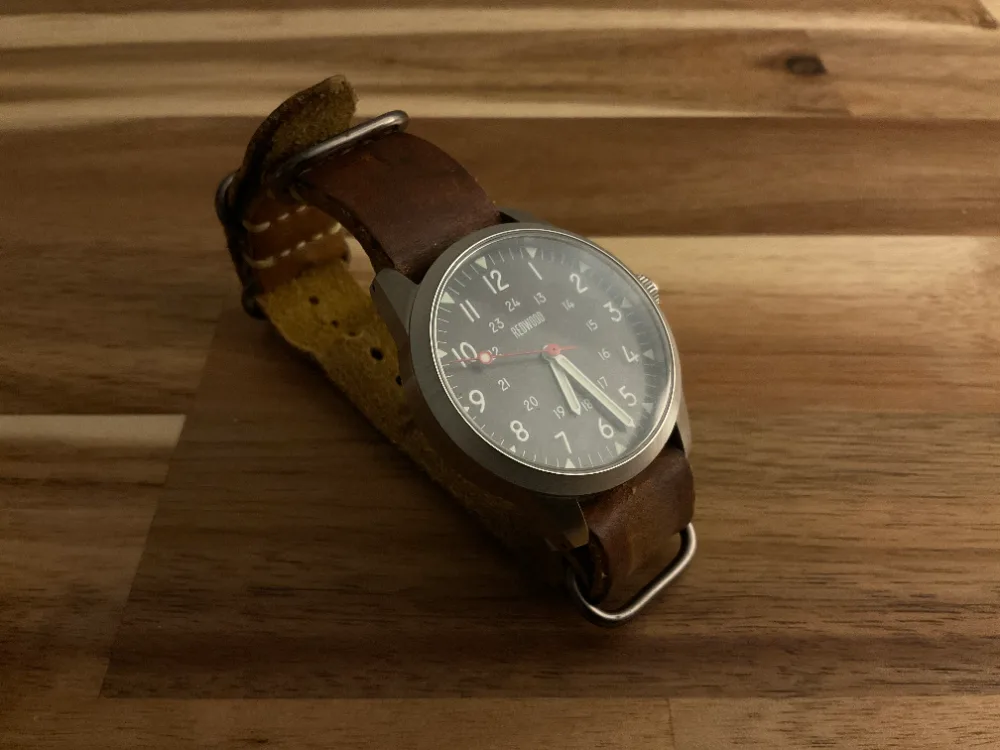
Inside beats an Epson VS37 solar quartz movement — energy independent, meaning no battery swap mid-expedition and hacking seconds for precise time-setting against a known reference. Above it, a flat sapphire crystal, 1.5mm thick and rated 9 on the Mohs scale (diamond being a 10), shrugs off the scrapes and knocks that would ruin lesser glass, while an internal anti-reflective coating keeps the dial crisp in bright light. And that dial is all business: matte finish, high contrast, large numerals with military time on the inner scale, and pencil-shaped hands treated with Super-LumiNova C3 for reading the hour in total darkness — with a red second hand there to confirm the movement is alive, at a glance. Total weight: a feather-light 56g without the strap. Leather, nylon, or rubber completes the kit.
Redwood, the Canadian touch
Redwood is the kind of company you hope to find at the end of one of those deep dives into the far corners of the web: a small, independent, family-run Canadian brand founded in 2014 by two brothers — engineers by trade, watch enthusiasts by conviction. Fed up with the old excuse that a good watch could only offer two of three virtues — good design, rugged construction, or fair price — they set out to prove all three could coexist in one case. With no corporate backers breathing down their necks, they're free from the usual pressure of sales targets and profit margins, and since 2020 their watches have been assembled in small batches in their own Canadian workshop. Their inspiration is drawn from military watches predating the First World War — instruments built to be tough, reliable, and accurate in the harshest environments — blended with the charm and elegance of vintage pieces, minus the fragility and maintenance anxiety that come with actual heirlooms. In their own words, it's less a company than a labor of love: a desire to share their twin passions for history and engineering, and to build watches you can strap on for any adventure without a second thought.
II. Wearing the Kilroy.— He was here, so was joy
Having worn quite a few watches, I know exactly what I need: a 40mm diameter. To me, that's the ideal size. I certainly have no appetite for those 44 or 46mm cases. Granted, my wrists aren't especially small. But I like a watch that fades into the background. And besides, I've never considered watches jewelry to put on display anyway.
The contrast between the numerals and the dial is perfect. The second hand doesn't sweep as smoothly as on a mechanical watch gliding around the dial, but to me, that's a minor detail.
This is my first solar watch, and knowing I'll never have to worry about changing batteries or recharging — well, the first thing that comes to mind is that if I'm ever stranded on a desert island someday, then hey… at least I'll know what time it is! And it can double as a sort of compass, too. That's already something, isn't it?
The imperfections tied to the quartz movement are fairly minimal. Then again, I'm no expert on the matter, so let's just say it doesn't bother me much. I reckon I'm running about 1 to 2 minutes off every six months. I imagine that's rather decent compared to other watches on the market.
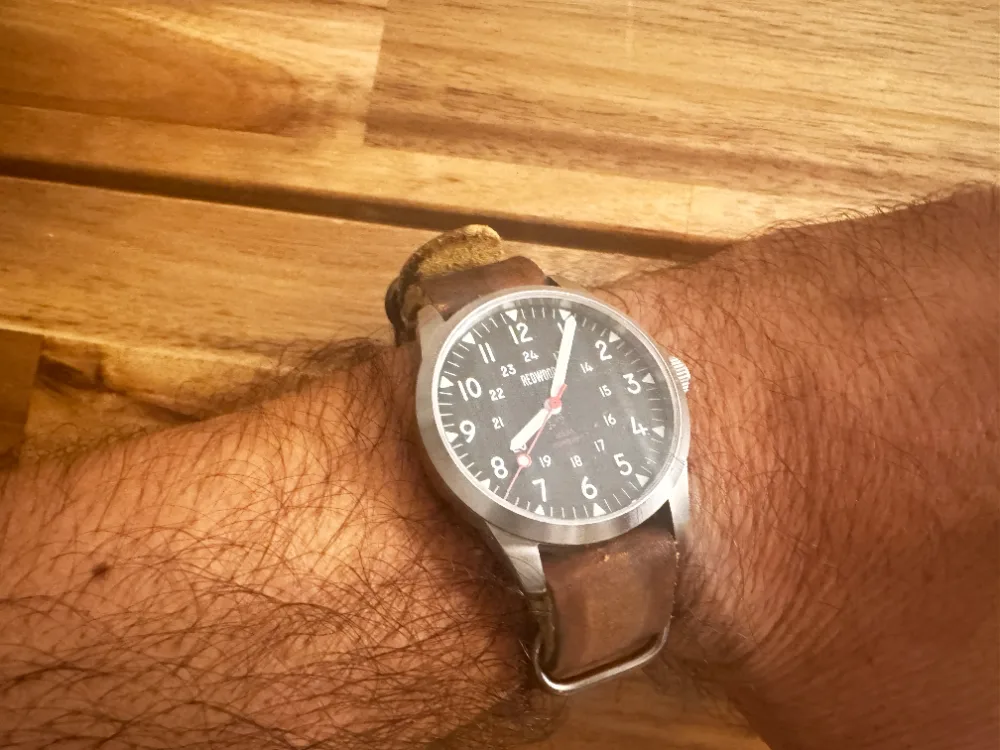
I have absolutely no hesitation diving into a pool, a river, a lake, or an ocean with the watch on my wrist. When the good weather arrives, usually around May, I swap the leather strap for a nylon NATO strap. I simply make sure the crown is screwed down tight.
Having reached out to them myself, the company assured me they had run a full battery of water-resistance tests on the watch. Why did I even ask? Once again, this comes back to my troubles with Hamilton. But we'll get to that another day.
The watch fades into the background so much that sometimes I forget I'm wearing it. Now and then, I'll knock my wrist against a tree, a post, or a wall. Okay, fair enough — put that way, it sounds like I walk around with my eyes closed… But it happens, maybe once every six months. And the sapphire crystal offers genuine protection. I still remember wrecking a watch in a fall when I was a kid.
The main issue I have with this watch is its nighttime legibility. The lume isn't particularly pronounced. At this stage, I don't know if it's my eyes or the watch itself—but I've worn watches that were far more readable in the dark. Then again, my vision may have been sharper back then... Still, Timex's active electroluminescent Indiglo system, where the entire dial lights up at the touch of a button, leaves little doubt in my mind by comparison.
III. The story behind Kilroy
Before it ever graced a dial, the name Kilroy belonged to the walls. During the Second World War, American GIs scrawled "Kilroy was here" wherever they were stationed, encamped, or merely passing through — ship holds, rail cars, bridges, and ruins across Italy, France, Japan, and the Philippines. The words almost always travelled with a doodle: a bald-headed man with a prominent nose, peering over a wall as if checking whether the coast was clear. The origins of both the phrase and the drawing are still argued over, and more than one man named Kilroy has claimed authorship. The most cited version points to James J. Kilroy, a rivet inspector at the Fore River Shipyard in Quincy, Massachusetts, who reportedly chalked the words on tanks he had checked and approved so his counts wouldn't be questioned. A rival account credits Sergeant Francis J. Kilroy, whose friend Sergeant James Maloney supposedly wrote "Kilroy will be here next week" on a barracks noticeboard in Boca Raton, Florida, while he lay sick with the flu — a line the airmen around him trimmed down and carried overseas.
The little man himself has a separate lineage. The bald figure peering over his wall is generally traced back to British troops in the First World War, where he was known as Mr. Chad — a fixture of rationing-era humour, often captioned "Wot, no sugar?". When American forces crossed paths with the sketch in the 1940s, they grafted it onto the Kilroy phrase, and the hybrid became one of the war's most recognisable marks. The effect on the other side was unexpected: Axis intelligence was said to be baffled by how ubiquitous the graffiti was, and the story goes that Hitler's circles came to suspect "Kilroy" was the codename of a senior Allied agent moving freely behind their lines. Whether or not that's true, the mark had done its job — it read as proof that no corner of Europe was truly beyond reach.
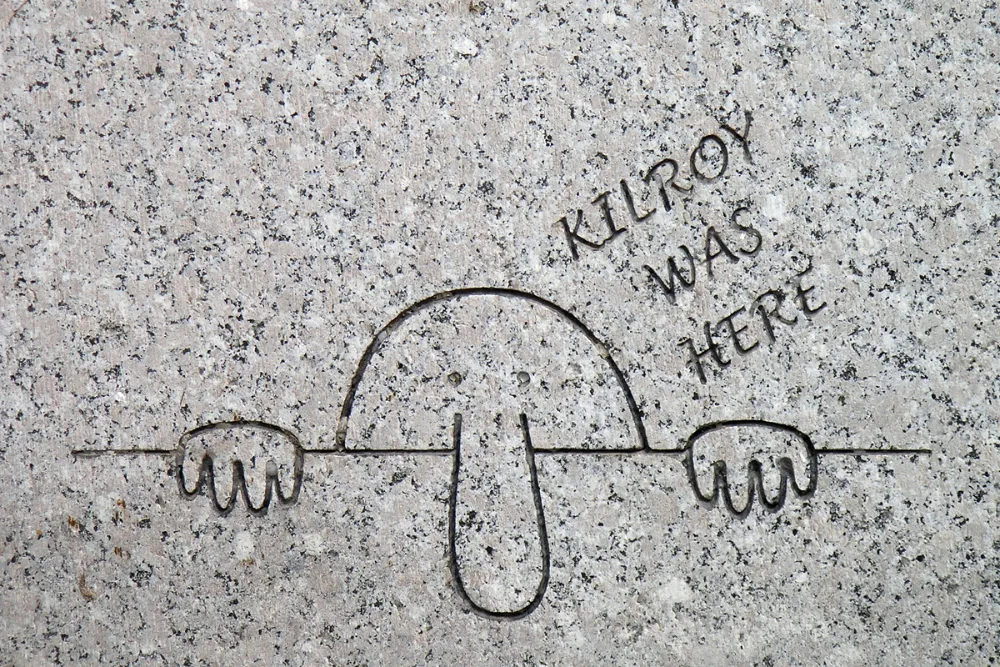
For the men in the foxholes, though, Kilroy meant something quieter than psychological warfare. Finding those three words on a wall you'd never seen before told you that someone had been there ahead of you — and, more importantly, that they had survived it. It was a signature passed from stranger to stranger, a reassurance that the road was walkable. That is the inheritance the Kilroy watch reaches for: not nostalgia for the hardware of the 1940s, but the idea behind it — a tool built to be relied upon, and a name that quietly says someone got through here before you. Whatever wall you're standing in front of, the odds are decent that Kilroy was already there.
IV. Final thoughts— Stop looking. It's gotta be a Redwood watch
So yes, I've found my little gem, and I'm rather pleased to own a watch for which I know I'm not paying half the price for marketing or a logo, but genuinely for its quality and craftsmanship.
Redwood remains a niche company, at least here in Europe. And that may well be why I like it so much. In fact, when the Kilroy was released, I was the first European to place an order!
I bought this watch three or four years ago, but the world has changed a great deal since. Customs policies certainly aren't helping small businesses that stubbornly insist on offering quality products at an affordable price. I remember buying the watch for 169 euros — December 2022, I believe. Its price has now risen to 273.95 euros. Yet the company's spirit hasn't changed, and the team still pursues the same goal: reliable field watches at a fair price, far from the big-name brands we all know.
So if you're looking for a fine watch, think twice before spending your salary on Hamilton, Tissot, and other great watchmaking houses. Go pay a visit to the Redwood website, if only to admire their growing collection inspired by the finest field, pilot, diver, and chronograph watches of the era. And above all, take a moment to compare the technical specifications. You'll see they've certainly got nothing to blush about.
Note : This article was not sponsored and I bought the watch myself